

The name
What is a triptych?
Three panels, hinged so the whole thing can be shut and opened again. We took the name because none of the three does its work alone.
The Art History Origin of the Triptych
Fifteen hundred years of painters working the same three boards. Some of what they hid in them is still being argued over, and one panel has been missing since 1934.
Act one
The form is invented
400 to 1200
A Roman consul held the office for a year and marked it by handing out ivory tablets with his own face carved on them. A few centuries later somebody in Constantinople looked at that hinge and worked out it would do just as well for keeping a saint in.
Rome / 487
Overwritten with the names of the dead
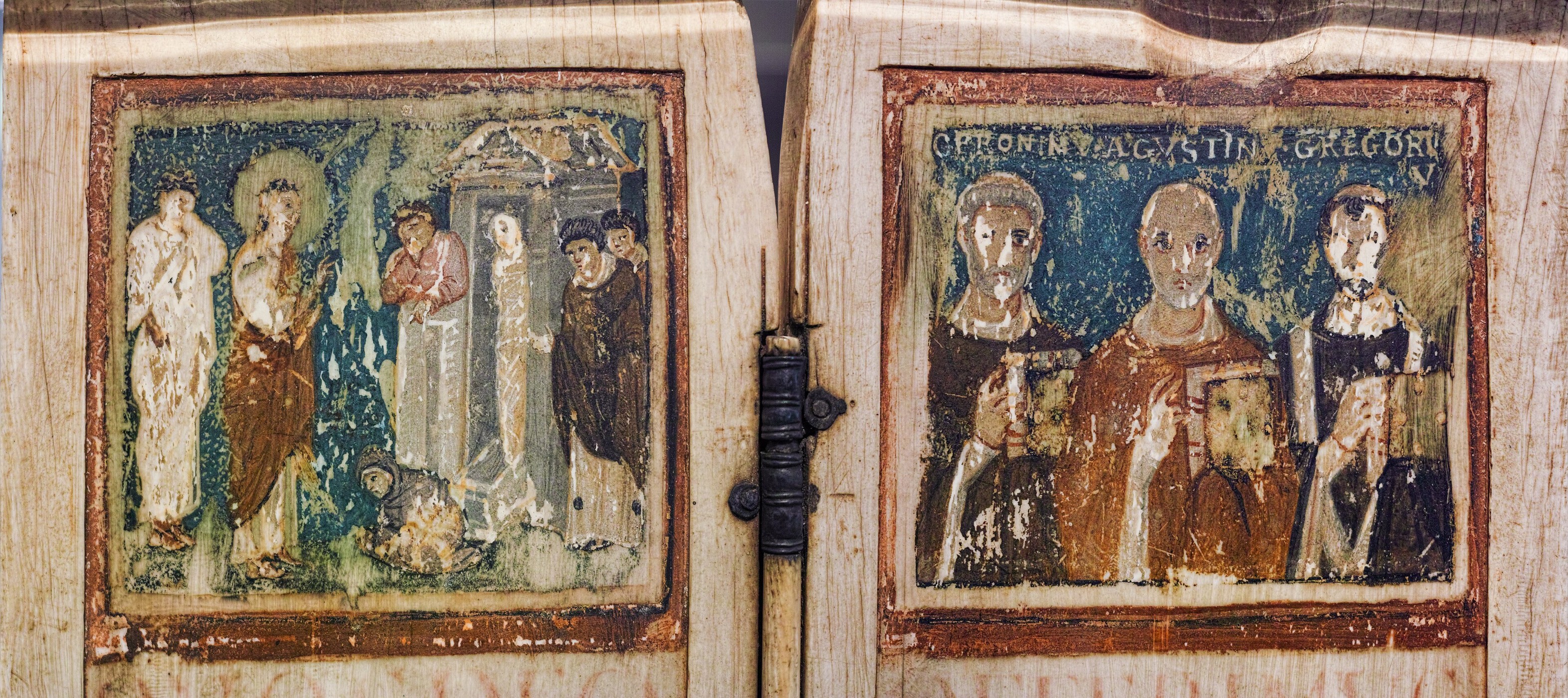
Diptych of Boethius, 487 CE, Museo di Santa Giulia, Brescia. Its reverse was overwritten twice with lists of Christian dead, once after 604 and again in the mid-8th century. A pagan magistrate's calling card, recycled as a parish death register. Hinged pairs like this one are the earliest multi-panel form, and everything on this page traces back to them.
Source: Wikimedia Commons(opens the catalogue record in a new tab)Rome / 506
Consular diptych of Areobindus
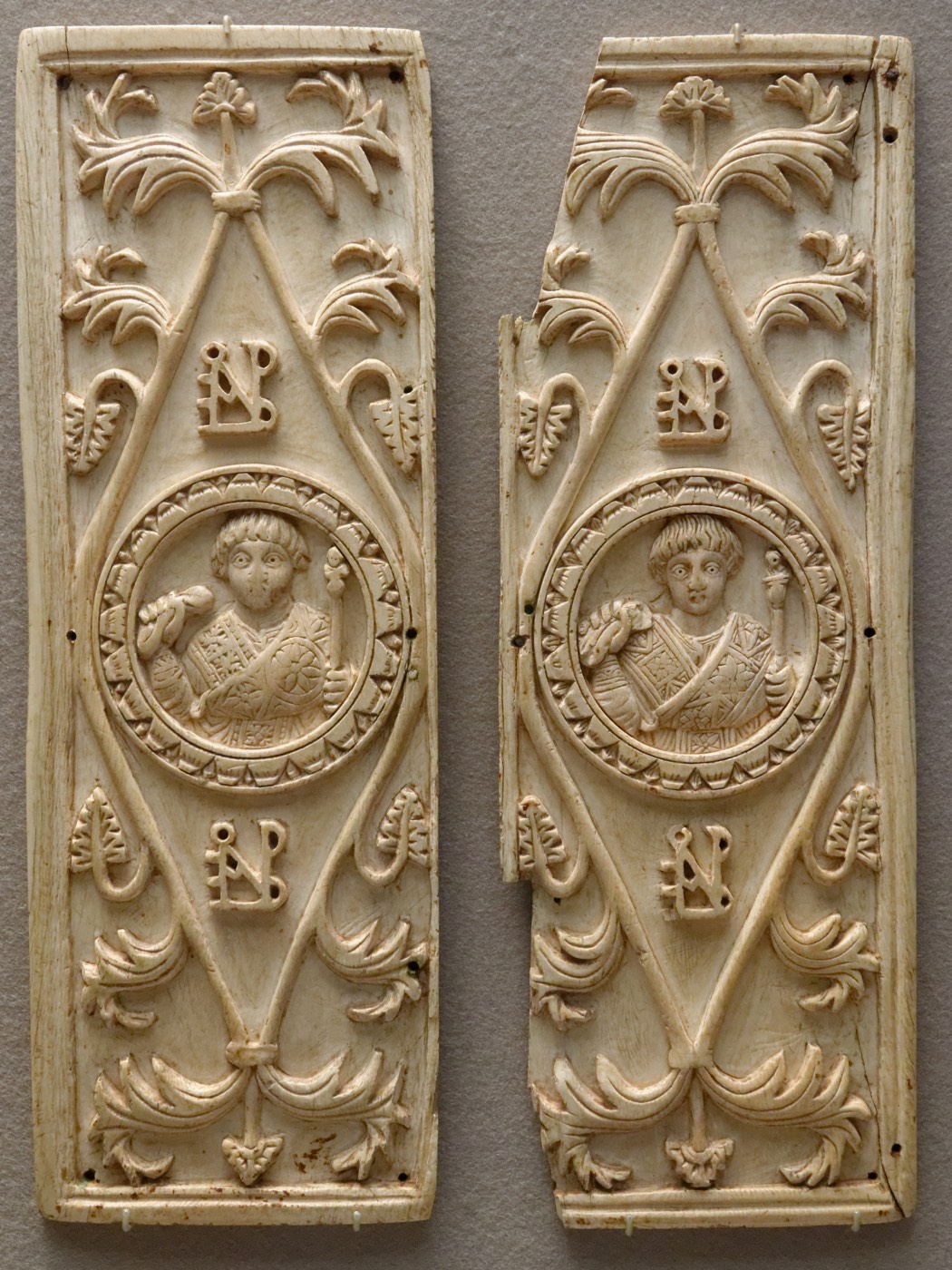
Consular diptych of Areobindus, 506 CE, ivory, Louvre. Five panels from his single year in office survive, scattered across Lucca, Zurich, Paris, Besancon and Dijon. Theodosius I made ivory diptychs a legally restricted consular privilege in 384.
Source: Wikimedia Commons(opens the catalogue record in a new tab)Japan / 7th c.
The Tamamushi Shrine
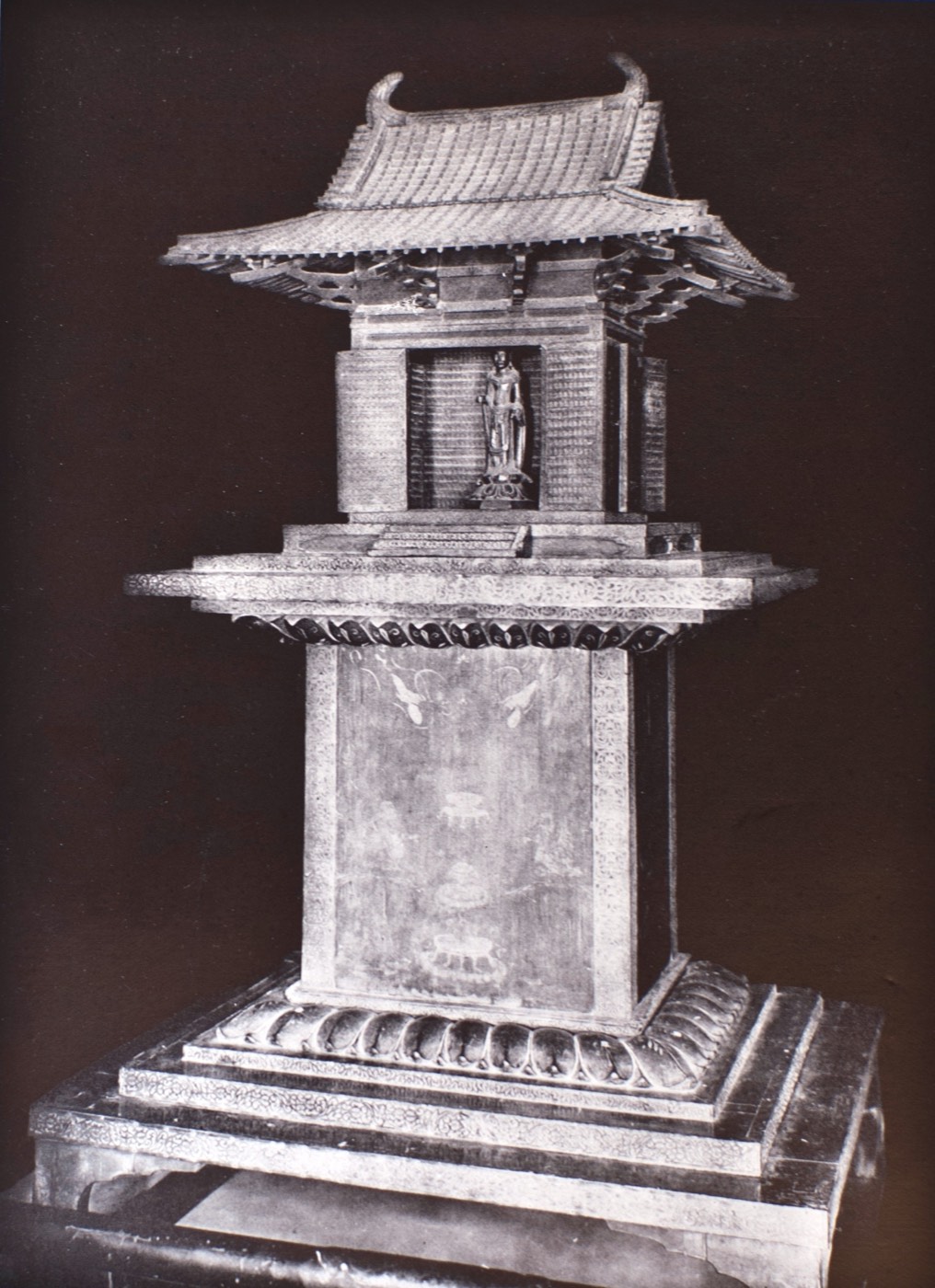
The Tamamushi Shrine, Horyu-ji, Nara, mid-7th century. A painted, doored, portable devotional shrine with jewel-beetle wing cases set under pierced bronze. It predates the Byzantine ivory triptychs by roughly three centuries and the Netherlandish altarpiece by eight.
Source: Wikimedia Commons(opens the catalogue record in a new tab)Byzantium / c. 940
The Harbaville Triptych
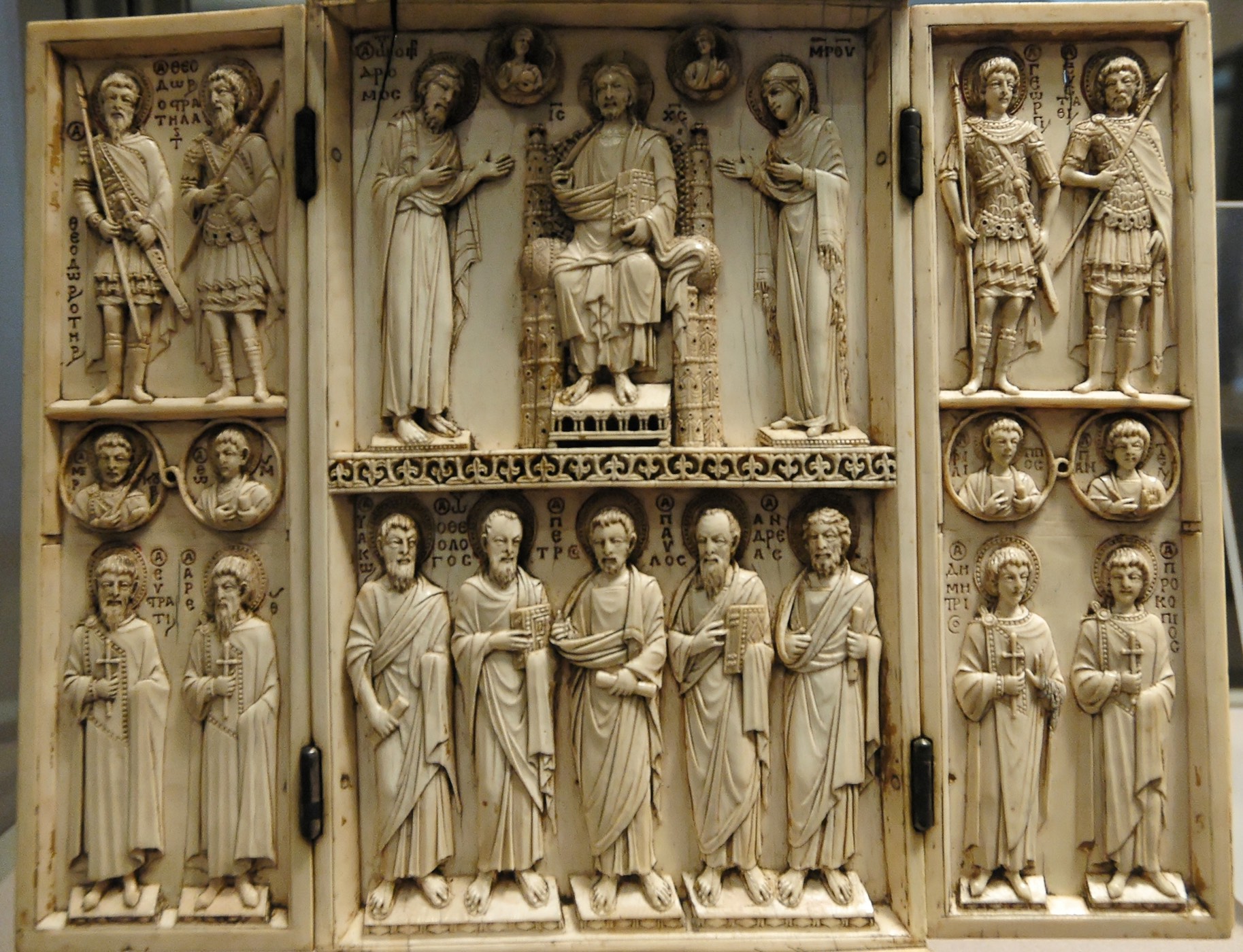
The Harbaville Triptych, Constantinople, c. 940-960, ivory, Louvre OA 3247. The finest surviving Byzantine ivory triptych: Christ enthroned between the Virgin and John the Baptist, ranks of saints on the wings.
Source: Wikimedia Commons(opens the catalogue record in a new tab)Medieval Europe / c. 1156
Byzantium nested inside a reliquary
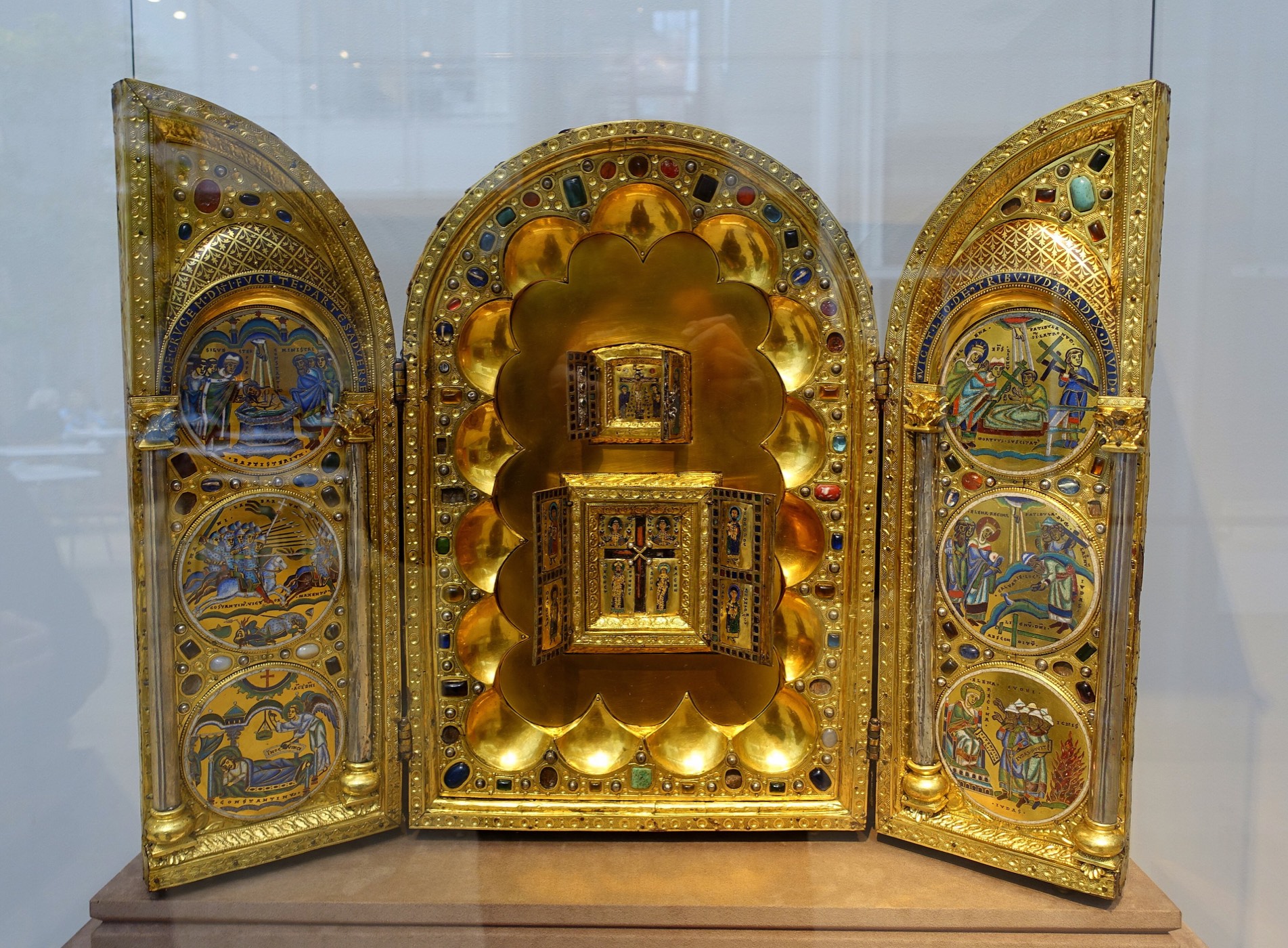
The Stavelot Triptych, c. 1156-58, Morgan Library. Abbot Wibald went to Constantinople to arrange a marriage for Frederick Barbarossa and came home with two small Byzantine reliquary triptychs, then commissioned a Mosan triptych to hold them. A triptych inside a triptych.
Source: Wikimedia Commons(opens the catalogue record in a new tab)Act two
The altarpiece era
1300 to 1600
Wings got bigger. Painters started working on both faces of every board, and the men paying for it all realised that funding an altarpiece meant you could be painted kneeling inside one, at the same size as the saints.
Trecento Italy / c. 1312
A cardinal's travelling altar
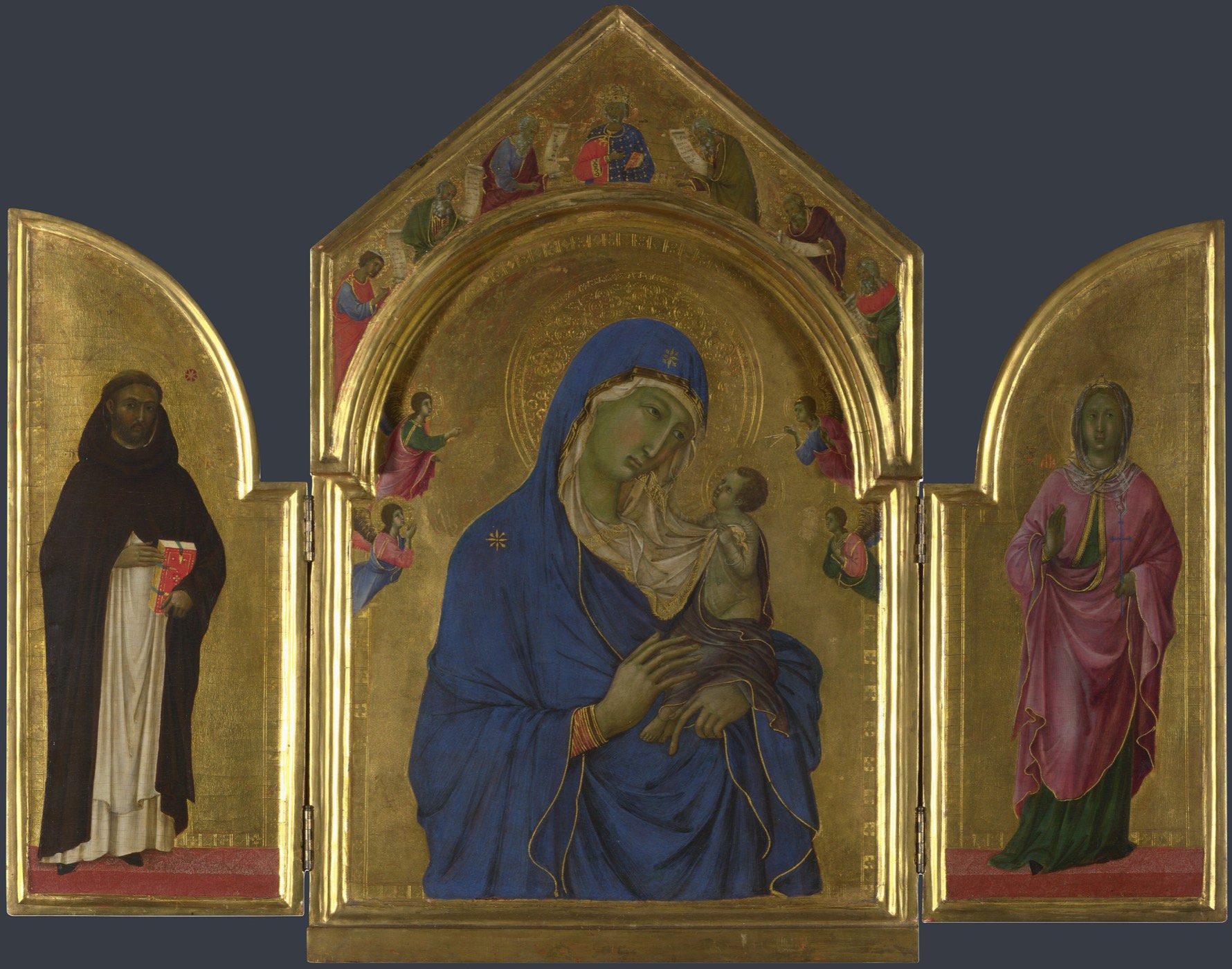
Duccio, The Virgin and Child with Saints Dominic and Aurea, c. 1312-15, National Gallery NG566. X-radiography shows where the original ring hinges were; it travelled with leather straps. Its near twin is in Boston, and the two may have been swapped by feast day.
Source: Wikimedia Commons(opens the catalogue record in a new tab)Trecento Italy / c. 1320
The altarpiece inside the altarpiece
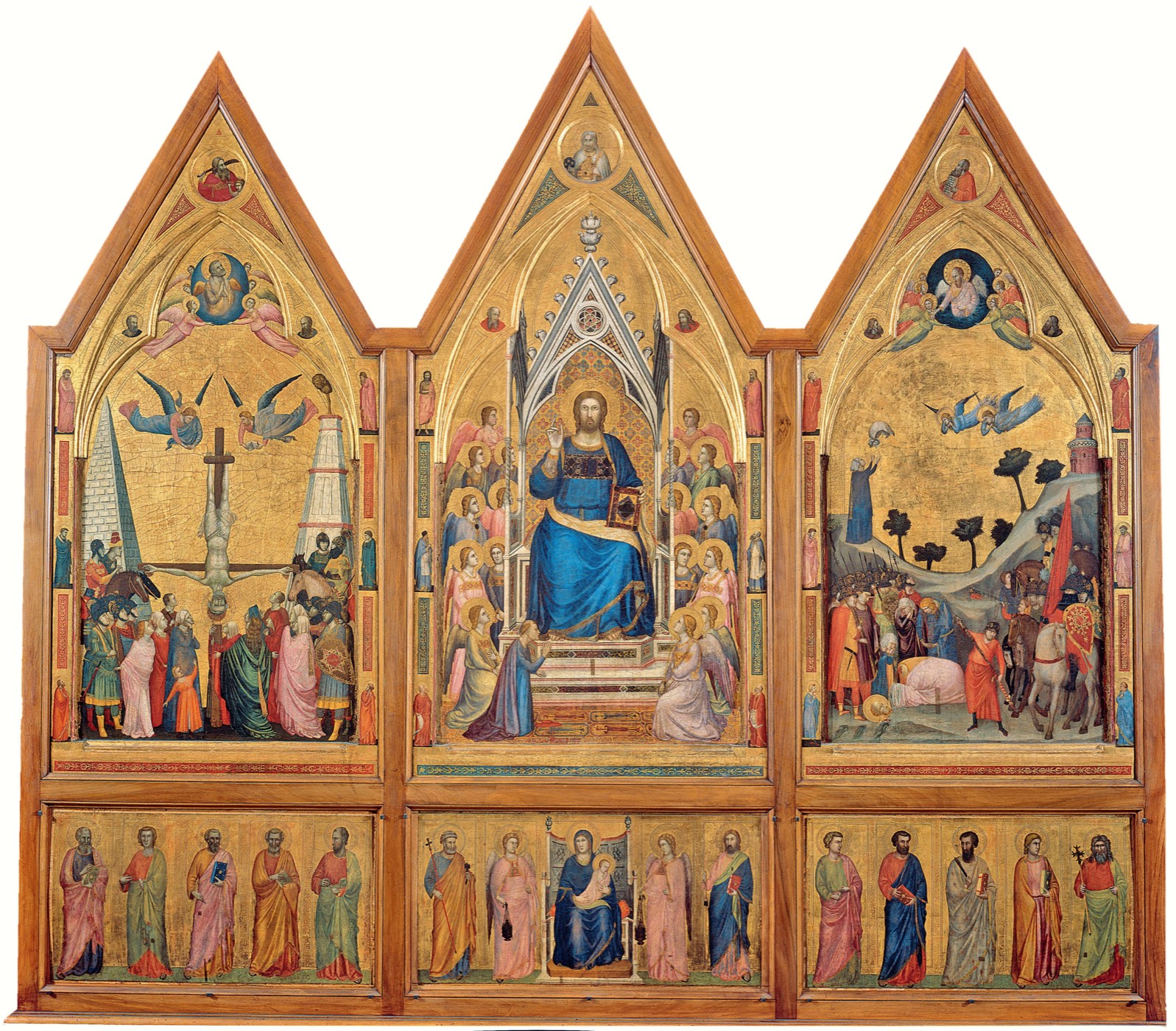
Giotto took the commission from Cardinal Jacopo Stefaneschi between 1315 and 1320, and his workshop did most of the painting. It was made for the canons' altar in the nave of Old St Peter's, which stood clear of the wall, so both faces had to be finished.
The miniature is on the canons' face. Stefaneschi kneels at Saint Peter's right holding a small painted copy of the altarpiece he is kneeling inside. He appears twice in the work, in cardinal's regalia on one side and plainer dress on the other.
The side shown here is the congregation's, which is why the copy within the copy is out of view. Old St Peter's was pulled down around it, and the panels are in the Pinacoteca Vaticana now.
Medieval Europe / c. 1330
Heraldry as the closed state
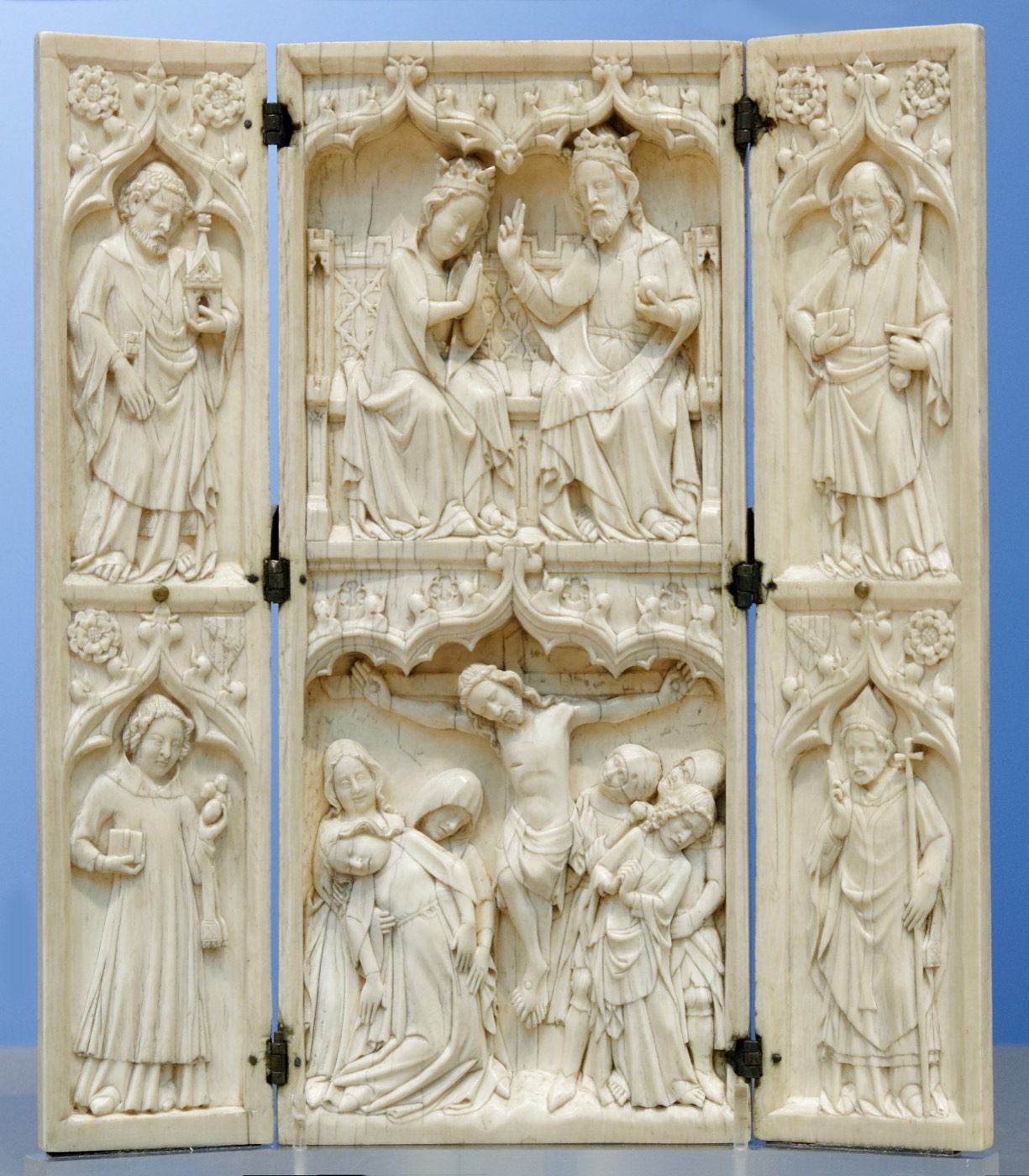
John Grandisson was bishop of Exeter from 1327 to 1369 and had the means to commission well. The triptych is elephant ivory, 23.8 centimetres tall, hung on two sets of three silver hinges, and it is reckoned one of the best preserved English ivories.
Opened, it gives the Coronation of the Virgin above the Crucifixion, with Thomas Becket carved on the right leaf. Grandisson had written a life of Becket, which makes that saint a personal choice as much as an English one.
The arms on the outer wings are his own, adapted from his family's by setting a mitre where an eaglet had been. Shut, the object gave the owner's name before it gave anything sacred. John Webb bought it for the British Museum in 1861.
The Netherlands / c. 1427
Joseph's mousetrap
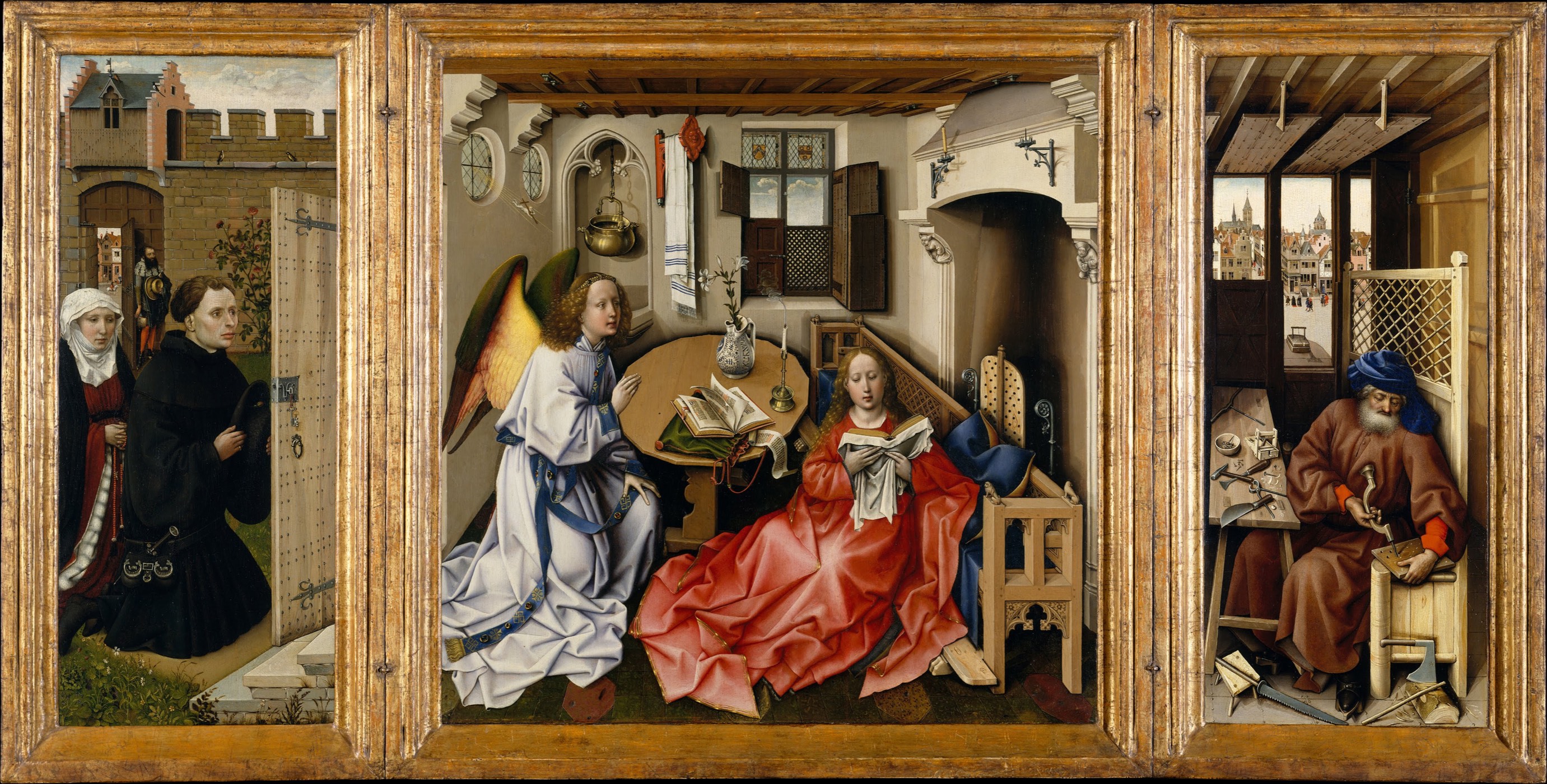
Workshop of Robert Campin, Annunciation Triptych (Merode Altarpiece), c. 1427-32, The Cloisters 56.70a-c. Joseph builds mousetraps: Augustine called the Cross the muscipula diaboli, the devil's mousetrap. Technical study shows the wings were added later and the donor's wife painted in afterwards.
Source: Wikimedia Commons(opens the catalogue record in a new tab)Ghent / 1432
The Mystic Lamb, open
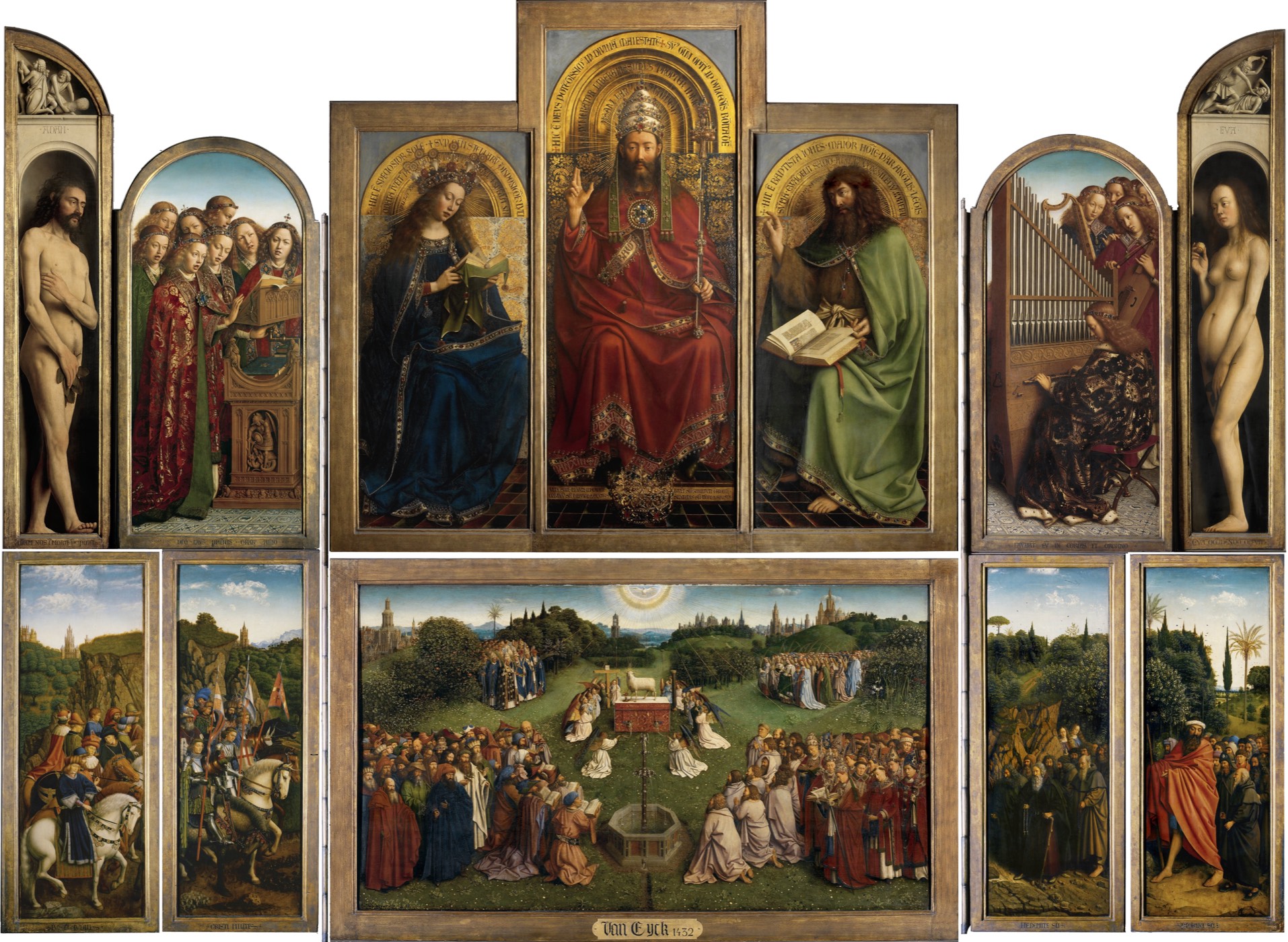
Hubert and Jan van Eyck, The Adoration of the Mystic Lamb, dedicated 6 May 1432, Saint Bavo's Cathedral, Ghent. Twelve panels, eight painted on both sides. The anchor work of the entire wing-altarpiece tradition.
Source: Wikimedia Commons(opens the catalogue record in a new tab)Ghent / 1432
The Mystic Lamb, open
Hubert and Jan van Eyck, The Adoration of the Mystic Lamb, dedicated 6 May 1432, Saint Bavo's Cathedral, Ghent. Twelve panels, eight painted on both sides. The anchor work of the entire wing-altarpiece tradition.
Source: Wikimedia Commons(opens the catalogue record in a new tab)Ghent / 1432
The Ghent Altarpiece, closed
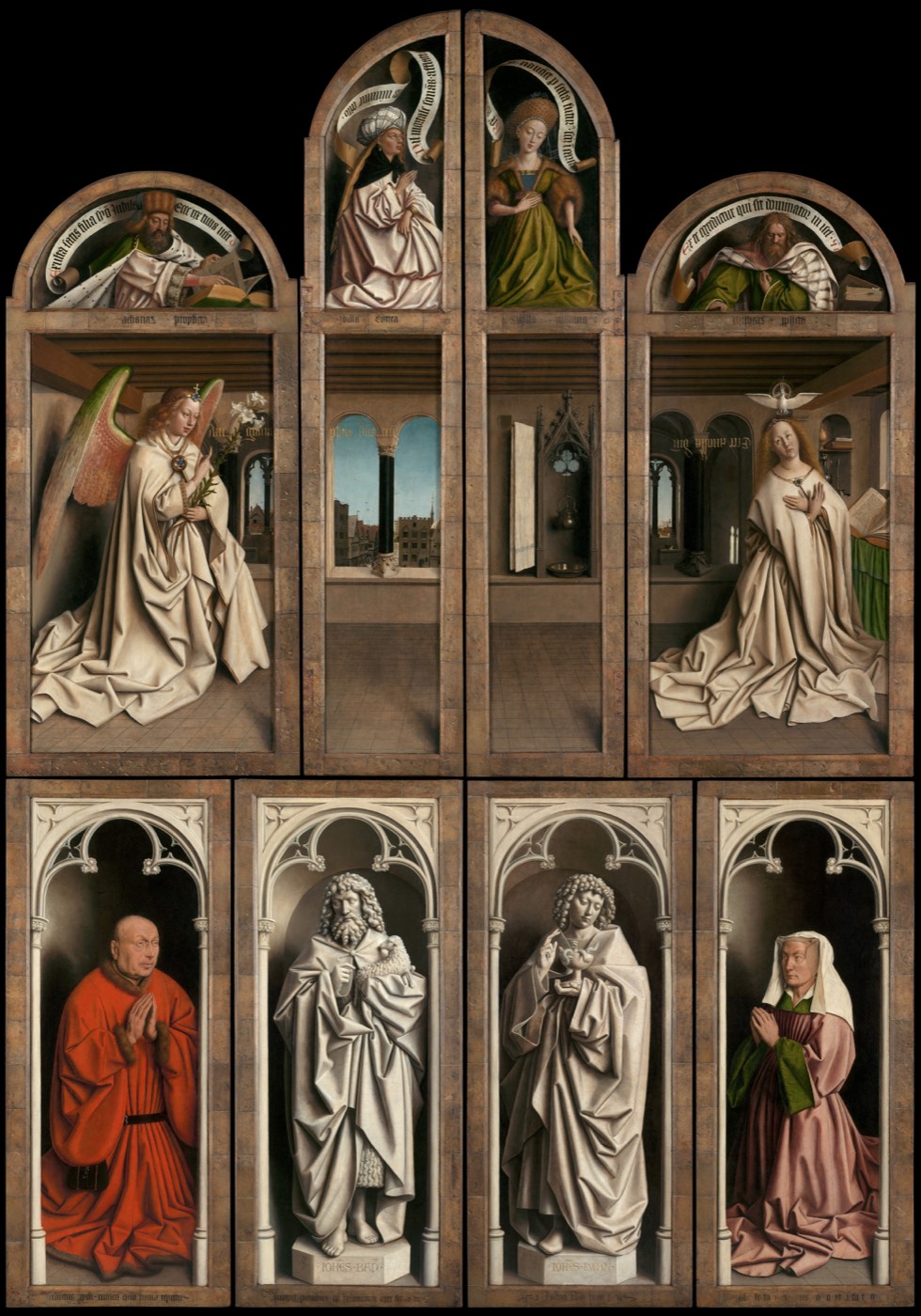
The Ghent Altarpiece closed, after restoration. Roughly 70 percent of the exterior turned out to be 16th-century overpaint. The painted frames cast shadows matching the real light of the Vijd Chapel. This grey face is what the public saw on ordinary days.
Source: Wikimedia Commons(opens the catalogue record in a new tab)Ghent / 1432
Still missing since 1934
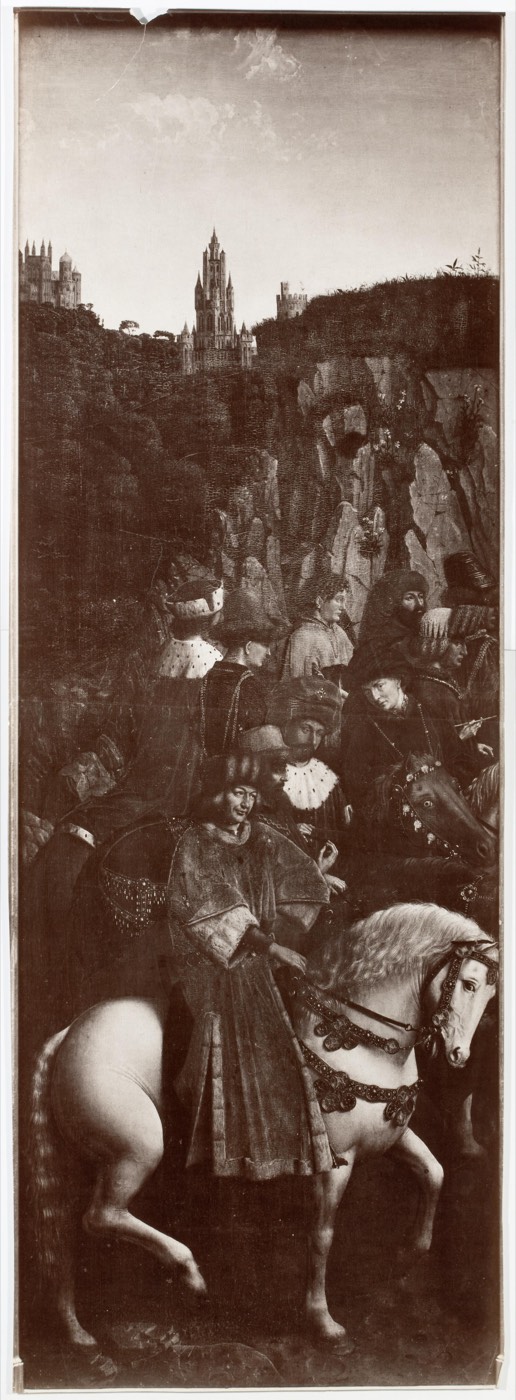
Somebody got into Saint Bavo's overnight on 10 April 1934 and left with two panels. One of them turned up again soon enough. The Just Judges has been gone ever since.
Ransom letters followed, all signed D.U.A., asking for a million Belgian francs. The money never changed hands. Ghent has kept the file open for more than ninety years and the Monuments Men and Women Foundation still carries the panel on its most-wanted list.
There is a copy in the frame now. Jef Van der Veken started painting it in 1939 and had it finished by 1945, though it took until 1957 to go up. He used a 200-year-old cupboard shelf for the panel, and he gave one of the horsemen the face of King Leopold III.
Ghent / 1432
In the Altaussee salt mine
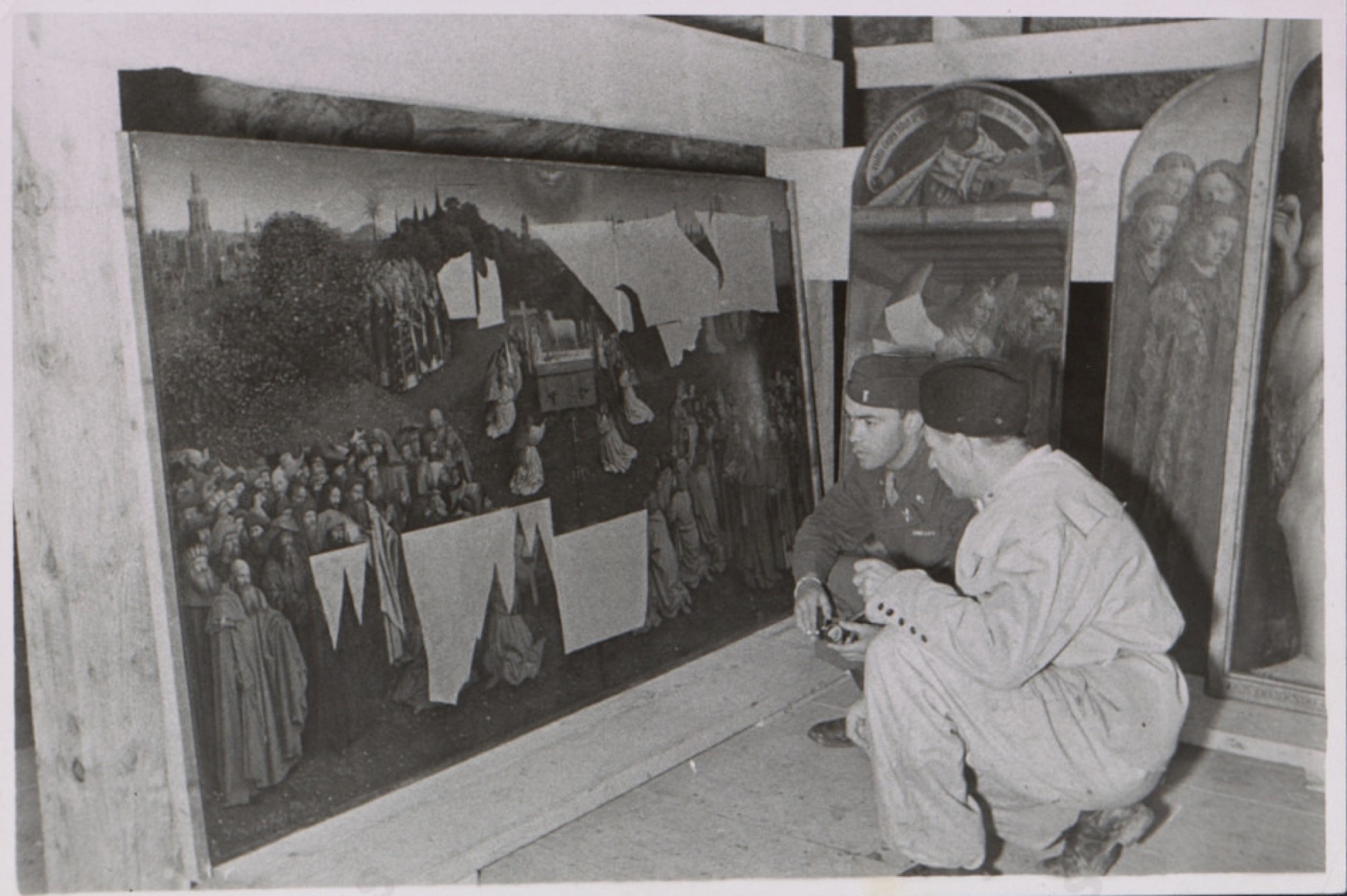
By 1945 the altarpiece was a long way underground in an Austrian salt mine, stacked in with a great deal of everything else the Reich had taken.
Gauleiter Eigruber had crates carried in and left among the art. Each one held an 1,100-pound bomb and each was stencilled Caution: Marble. The miners went back down and carried them out again on 3 May 1945.
The two men in the photograph are Daniel J. Kern, one of the Monuments Men, and a restorer called Karl Sieber, going over the panels underground.
Van der Weyden / c. 1440
A triptych made by cutting
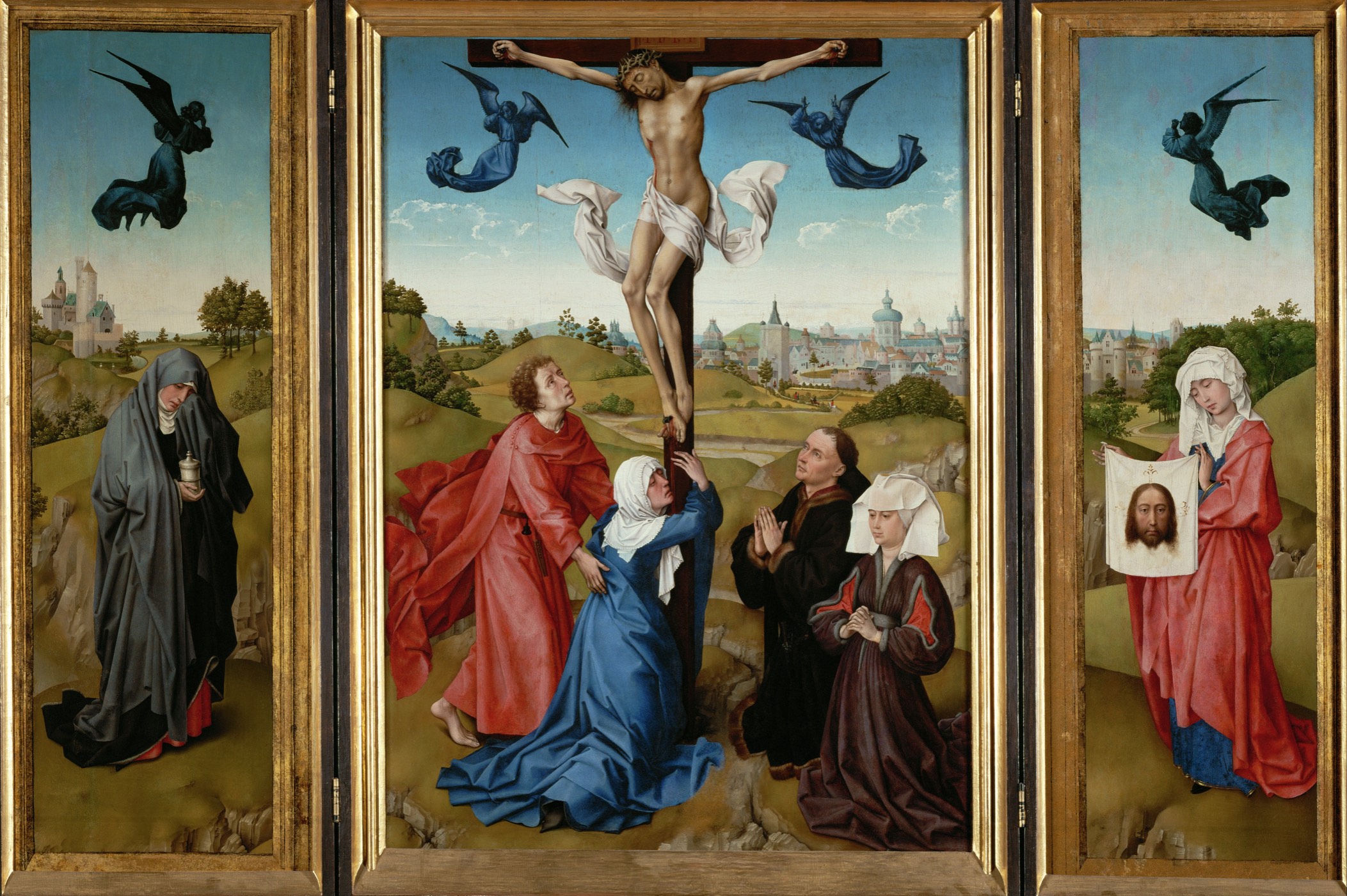
Rogier van der Weyden, Crucifixion Triptych, c. 1440, Kunsthistorisches Museum Vienna, inv. 901. The museum's own catalogue argues it began as a single panel with a painted frame and was later sawn into three. The unbroken landscape running behind all three sections is the giveaway.
Source: Wikimedia Commons(opens the catalogue record in a new tab)Van der Weyden / c. 1443
Aimed at the dying
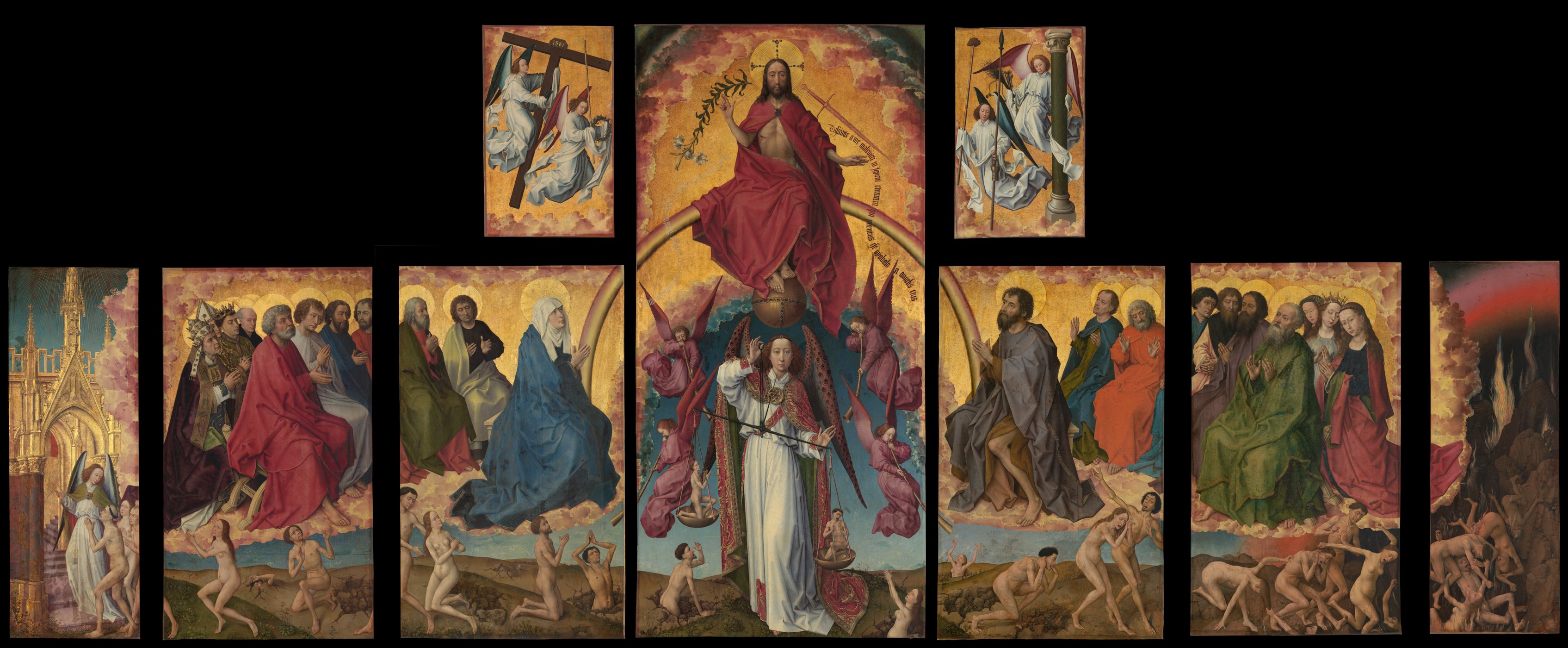
Rogier van der Weyden, The Last Judgment (Beaune Altarpiece), c. 1443-51, Hospices de Beaune. Nicolas Rolin stipulated that beds be placed within sight of it. The dying looked at the Last Judgment from their pillows, through a pierced screen.
Source: Wikimedia Commons(opens the catalogue record in a new tab)Bouts / 1464
The contract that specified bread
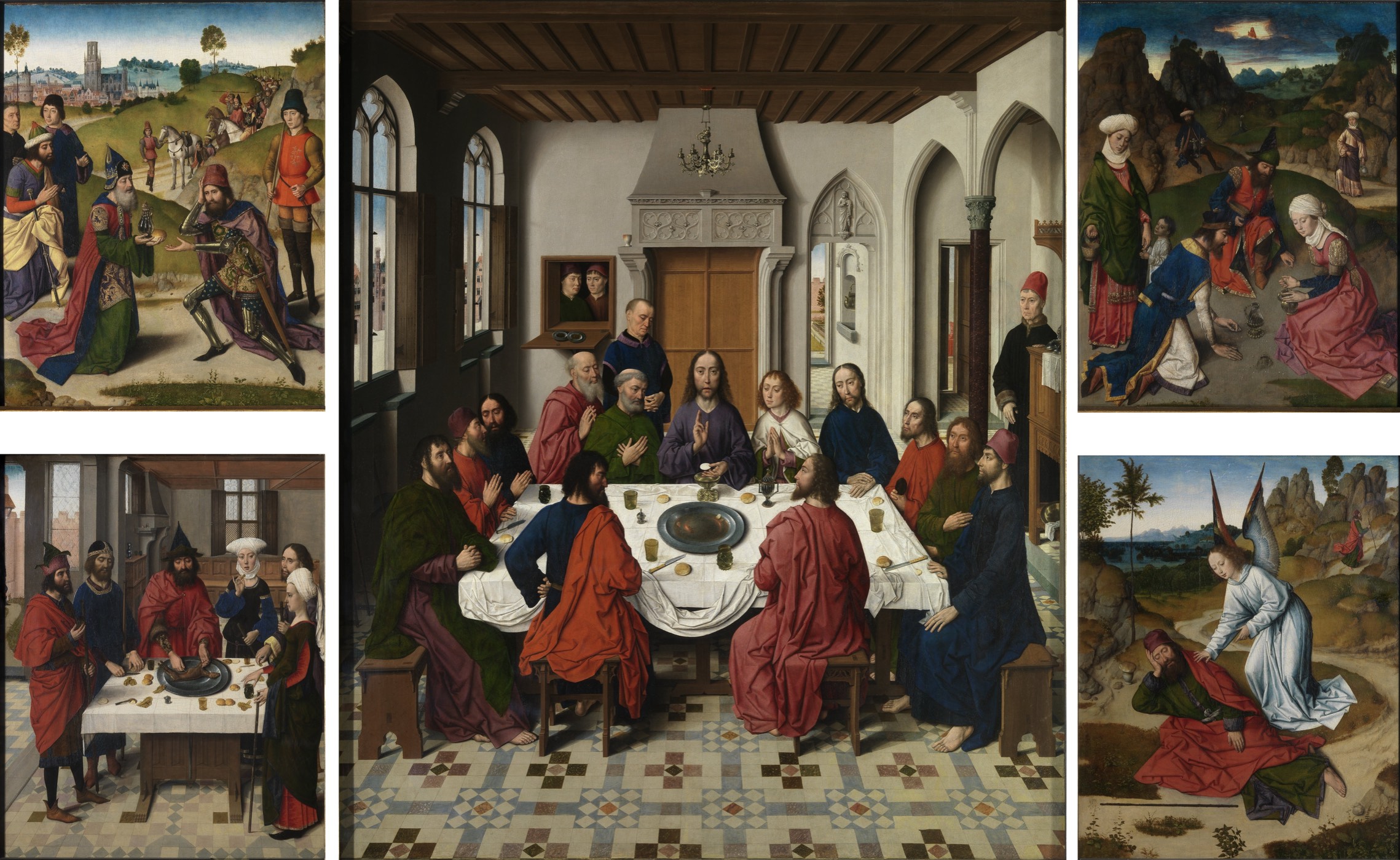
Dieric Bouts, Altarpiece of the Holy Sacrament, contracted 15 March 1464, St Peter's, Leuven. Two university theologians supervised the programme and the contract required every scene to contain bread. Its wings were sold to Bavaria and Berlin, and returned under Article 247 of the Treaty of Versailles.
Source: Wikimedia Commons(opens the catalogue record in a new tab)Memling / c. 1467
The pirate triptych
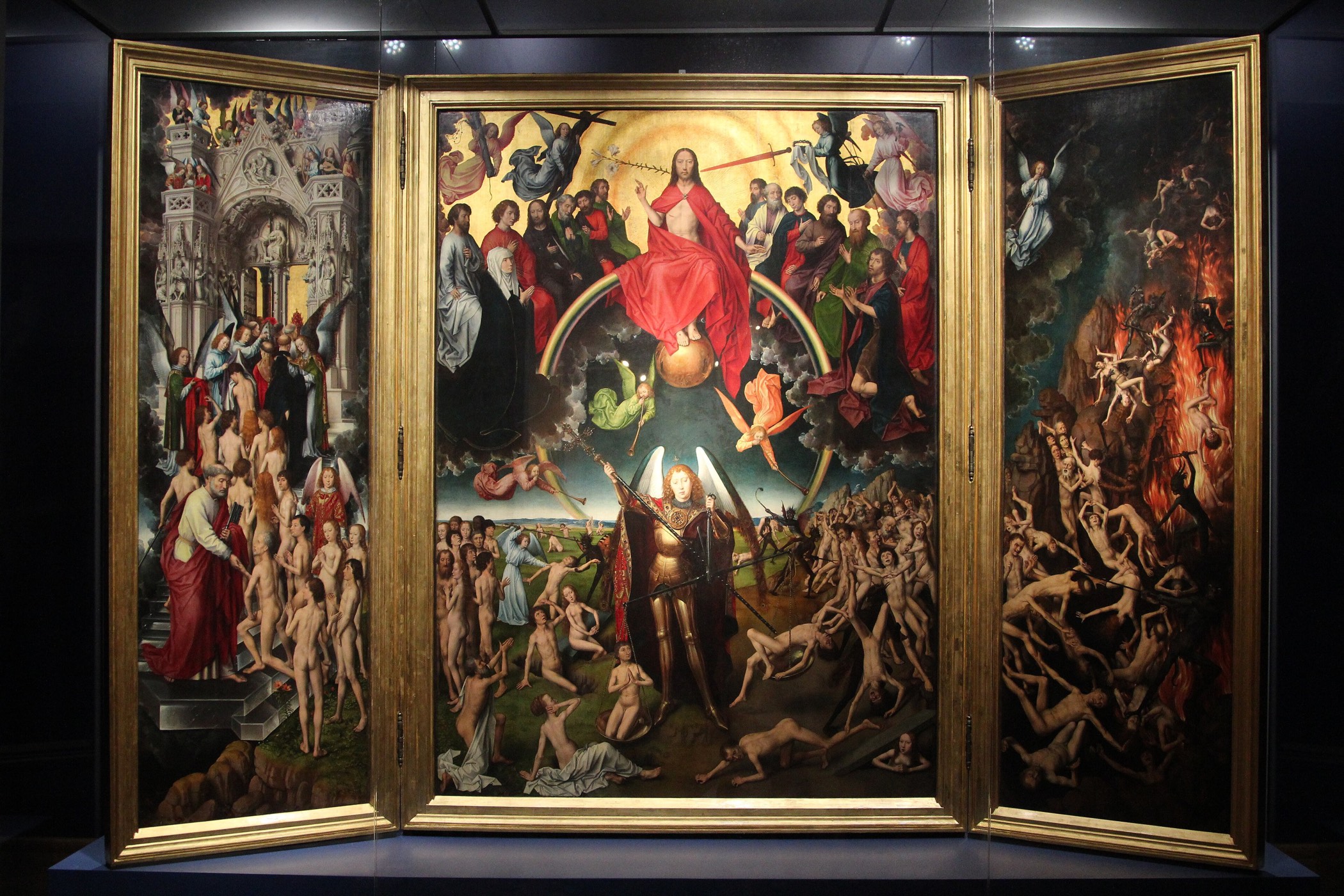
Angelo Tani banked for the Medici. He ordered a Last Judgment from Memling and put it aboard a galley called the San Matteo to go home to Florence.
A Danzig privateer called Paul Beneke took the ship in 1473. The painting went to Gdansk, and it has been in Gdansk for five and a half centuries.
Rudolf II offered forty thousand thalers. Peter the Great tried asking for it as a present. Gdansk turned down both of them.
Van der Goes / c. 1475
The shock that changed Florence
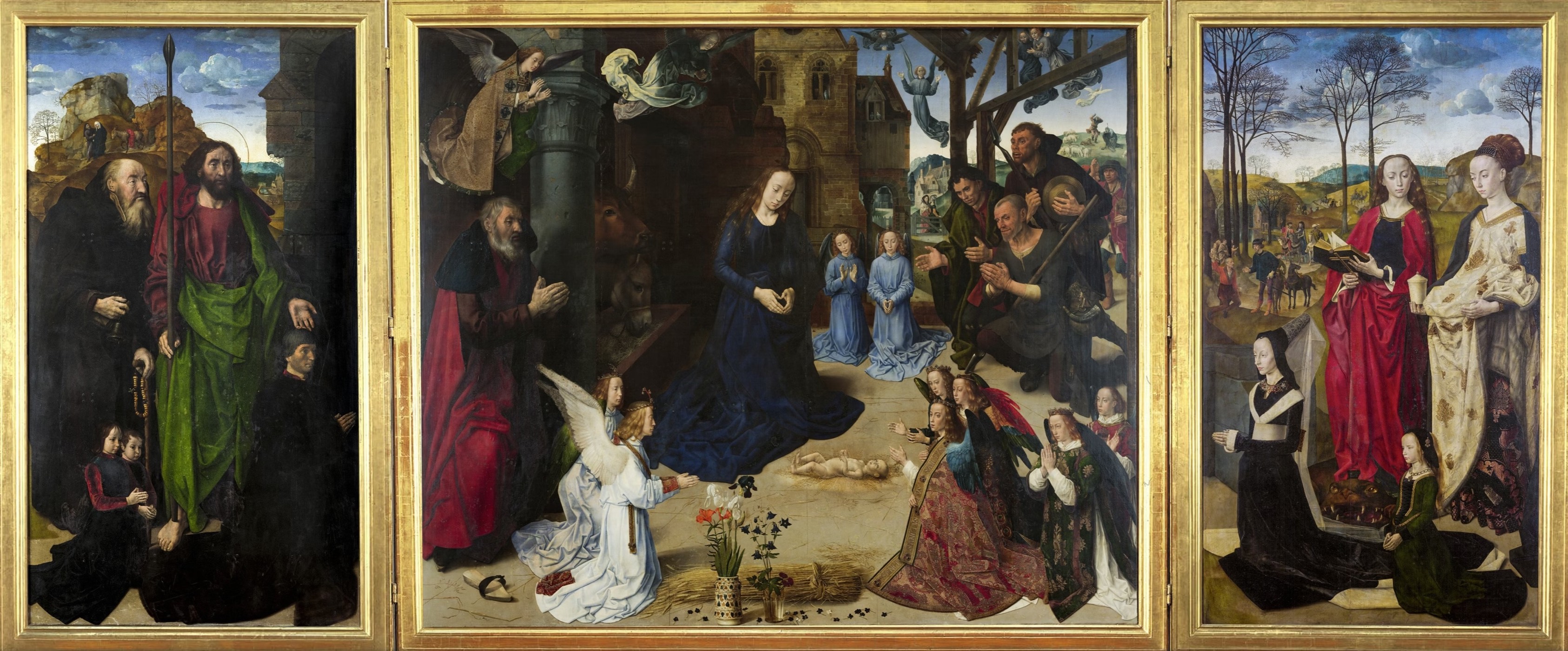
Hugo van der Goes, Portinari Triptych, c. 1475, Uffizi. It reached Florence on 28 May 1483, shipping paid by another banker because Portinari was ruined. Within two years Ghirlandaio had rebuilt his Sassetti Chapel Adoration around it.
Source: Wikimedia Commons(opens the catalogue record in a new tab)Bosch / c. 1490
The Garden of Earthly Delights
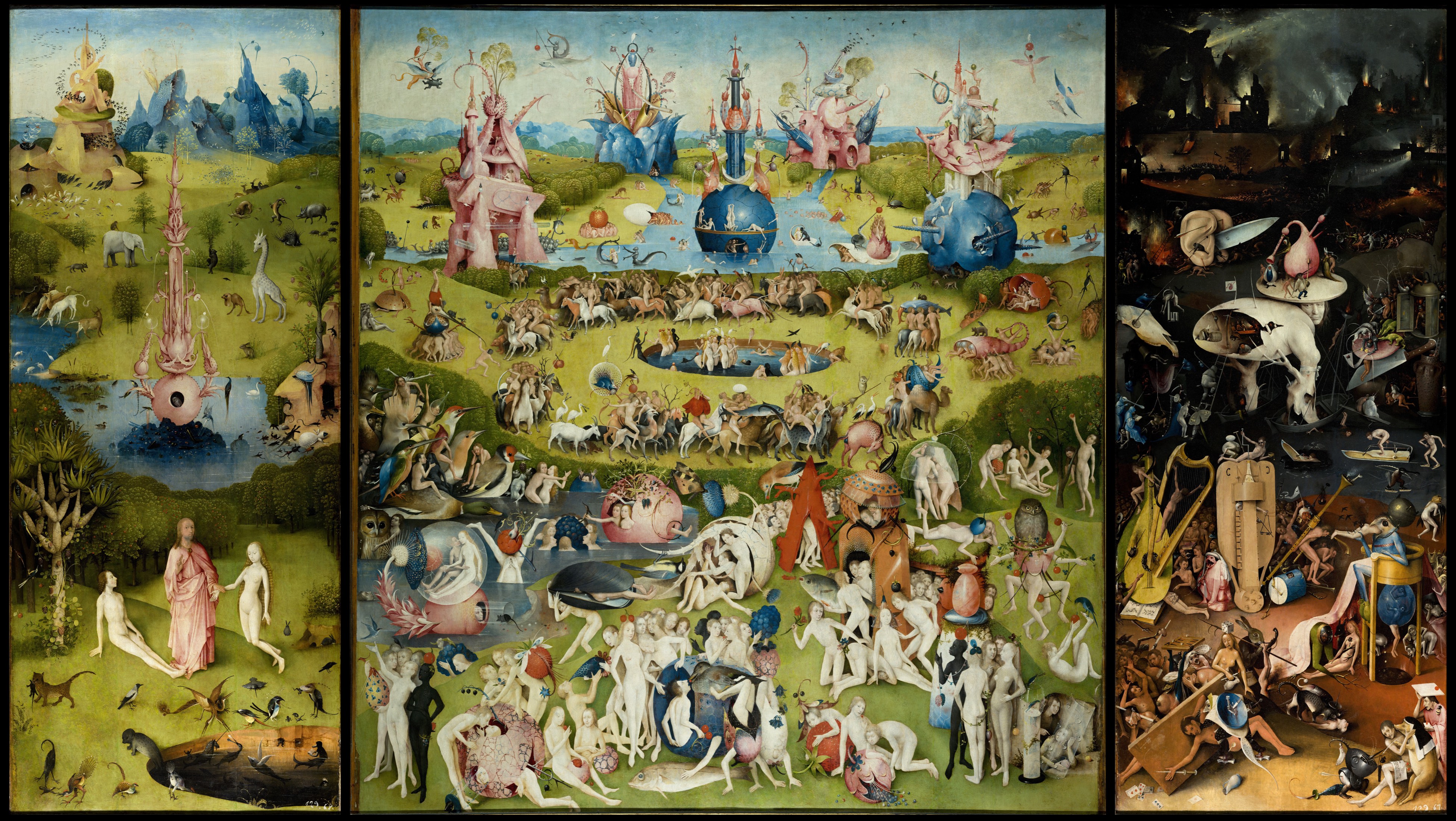
Hieronymus Bosch, The Garden of Earthly Delights, c. 1490-1510, Prado P02823. Dendrochronology puts the oak boards at 1460-66. Seen in the Nassau palace in Brussels in 1517, confiscated by the Duke of Alba in 1568, bought by Philip II in 1591.
Source: Wikimedia Commons(opens the catalogue record in a new tab)Bosch / c. 1490
The Garden of Earthly Delights
Hieronymus Bosch, The Garden of Earthly Delights, c. 1490-1510, Prado P02823. Dendrochronology puts the oak boards at 1460-66. Seen in the Nassau palace in Brussels in 1517, confiscated by the Duke of Alba in 1568, bought by Philip II in 1591.
Source: Wikimedia Commons(opens the catalogue record in a new tab)Bosch / c. 1490
The butt music of hell
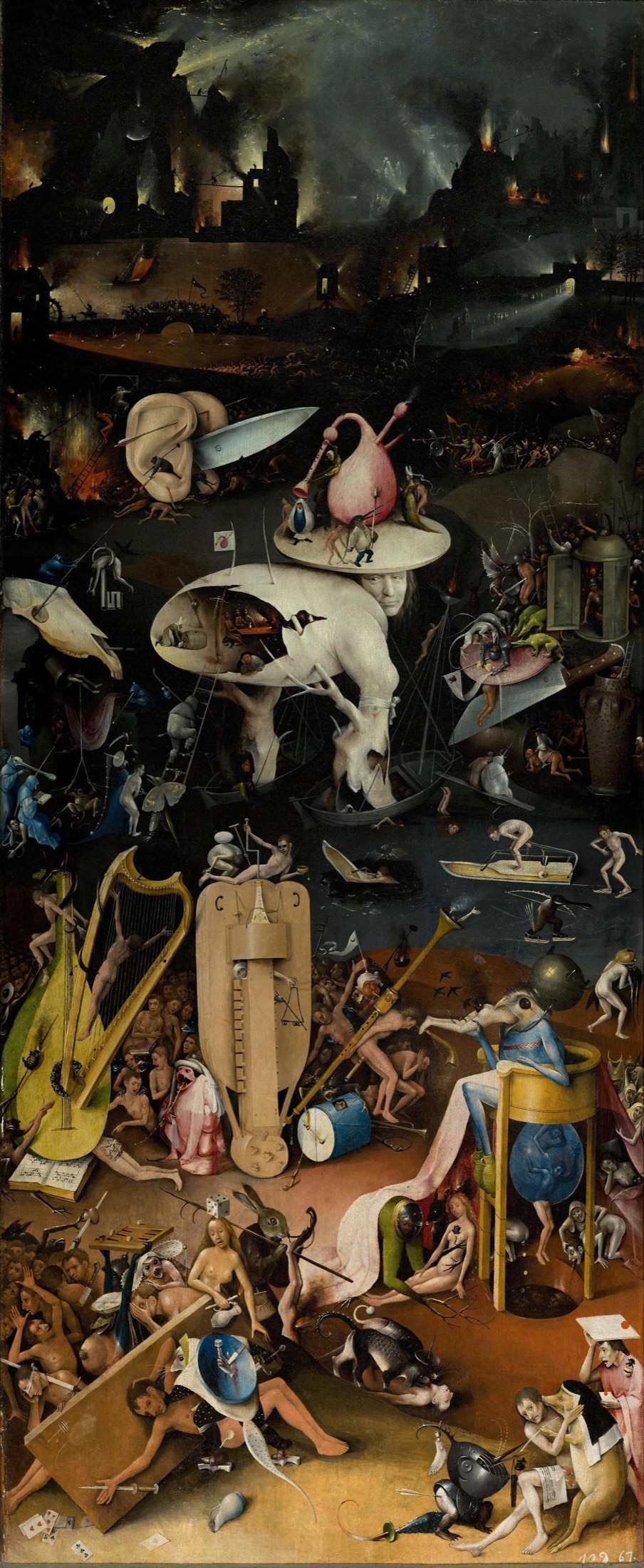
There is a choir down in the right-hand panel of the Garden. They are reading off a score, and Bosch painted that score across a damned man's backside.
An undergraduate in Oklahoma transcribed the notes in 2014, played them, and put the recording online, where it reached more people in a week than five centuries of Bosch scholarship managed between them.
Musicologists have spent the years since pointing out that the marks carry no clef, nothing written underneath them, and were never chant notation to begin with, which has done nothing at all to slow the recording down.
Medieval Europe / c. 1500
The triptych shrunk to fit a palm
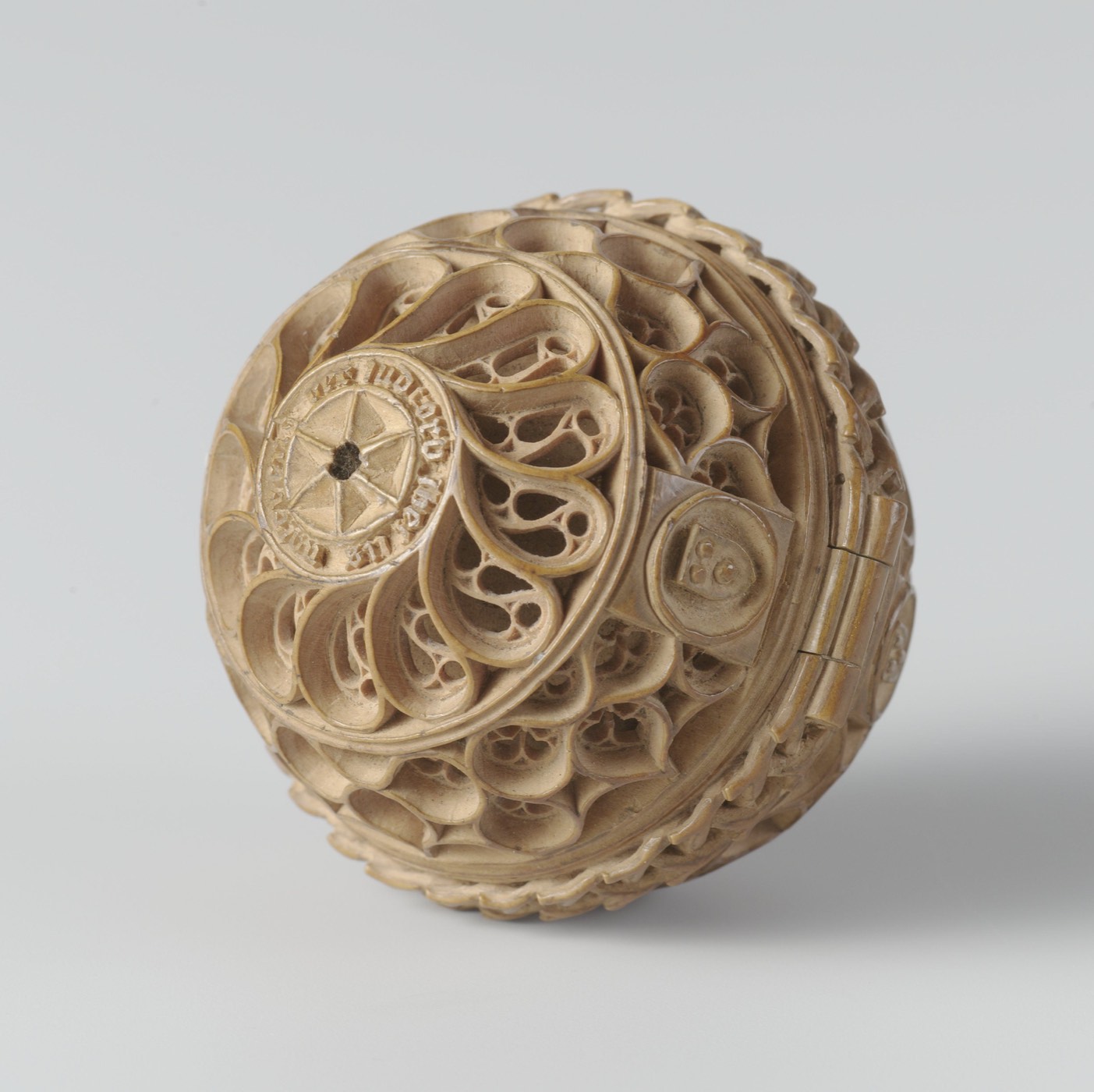
Prayer nut of Eewert Jansz van Bleiswick, Rijksmuseum BK-1981-1. A hinged boxwood sphere 30 to 65 mm across, carved with entire crowded scenes inside. Micro-CT scanning in 2016-17 finally revealed how they were assembled.
Source: Wikimedia Commons(opens the catalogue record in a new tab)Isenheim / 1512
The altarpiece as medicine
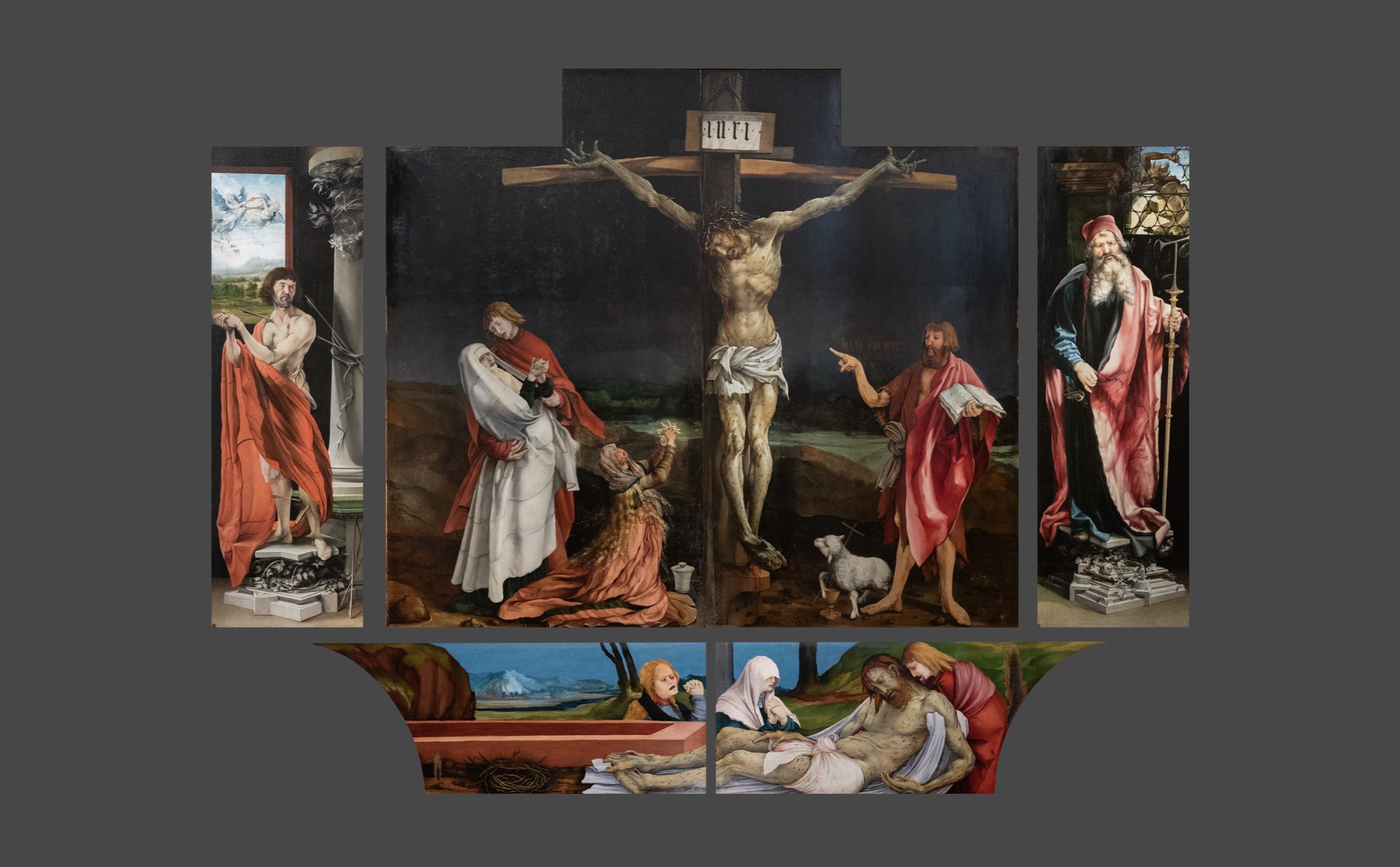
Grunewald and Niclaus of Haguenau, Isenheim Altarpiece, 1512-16, Musee Unterlinden, Colmar. Two sets of wings, three states. It stood in the chapel of a hospital run by the Antonites, who treated ergotism, and Christ's sores mirror the patients' own.
Source: Wikimedia Commons(opens the catalogue record in a new tab)Act three
The form breaks apart
1566 to 1969
In August 1566 crowds went through the churches of Flanders taking the images down. Whatever came through that got sold off in pieces over the next three hundred years by dealers who found a single wing much easier to shift than a whole altarpiece, and then a war arrived and put a great deal of what was left underground.
Iconoclasm / 1566
The Beeldenstorm of 1566
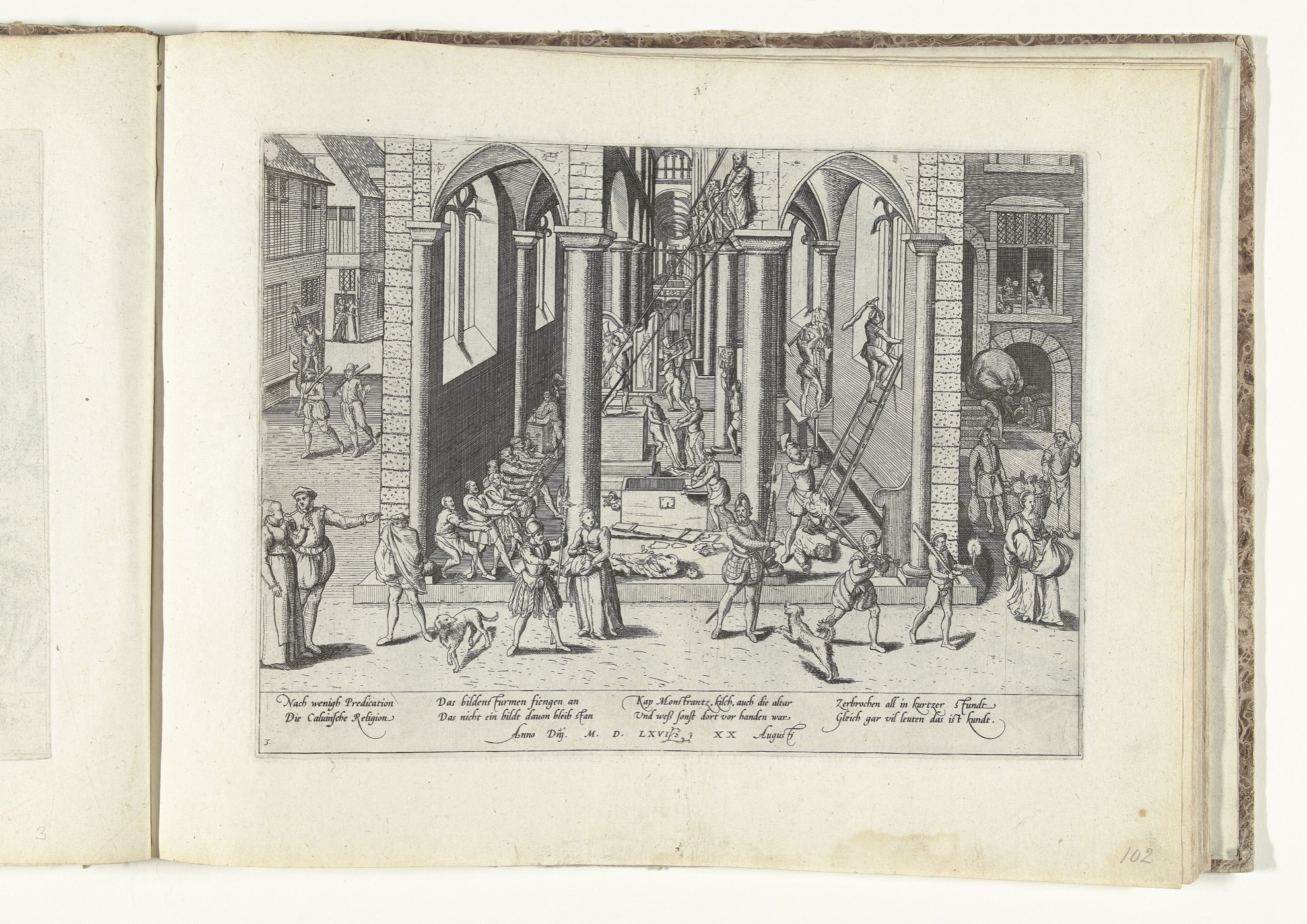
The Beeldenstorm, 1566. It began at Steenvoorde on 10 August and reached Ghent on 22 August; over 400 churches were attacked in Flanders alone. Carved centres burned; flat painted wings were portable enough to be carried out. That is why so many museum paintings are orphaned wings.
Source: Wikimedia Commons(opens the catalogue record in a new tab)Rubens / 1612
The Descent from the Cross
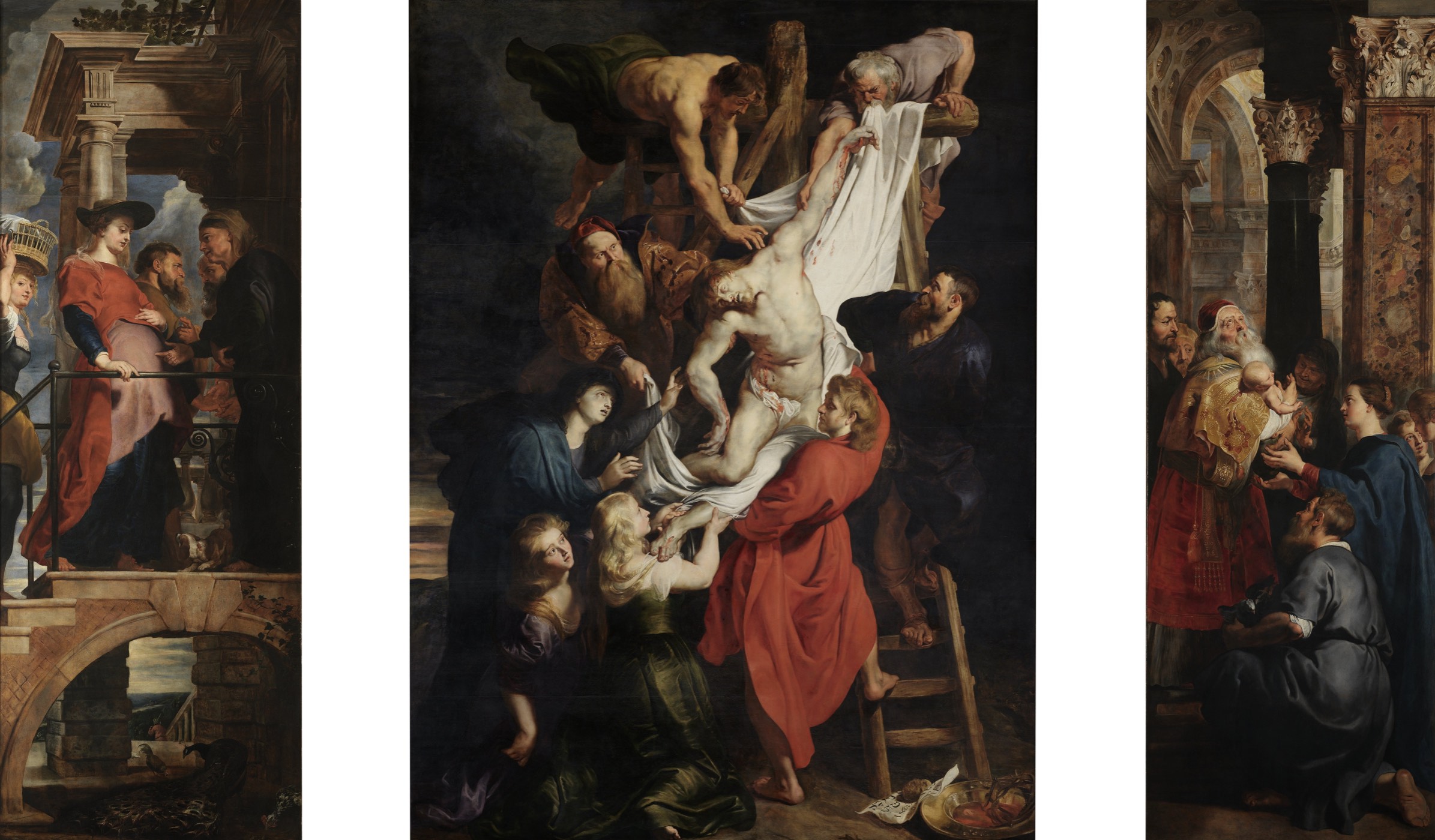
Rubens, The Descent from the Cross, 1612-14, Cathedral of Our Lady, Antwerp. Commissioned by the Confraternity of Arquebusiers, whose patron was Saint Christopher, the Christ-bearer. Every interior scene is a bearing of Christ. Taken to the Louvre in 1794, returned in 1815.
Source: Wikimedia Commons(opens the catalogue record in a new tab)Rubens / 1612
The Descent from the Cross
Rubens, The Descent from the Cross, 1612-14, Cathedral of Our Lady, Antwerp. Commissioned by the Confraternity of Arquebusiers, whose patron was Saint Christopher, the Christ-bearer. Every interior scene is a bearing of Christ. Taken to the Louvre in 1794, returned in 1815.
Source: Wikimedia Commons(opens the catalogue record in a new tab)Theft / 1633
The empty frames at the Gardner
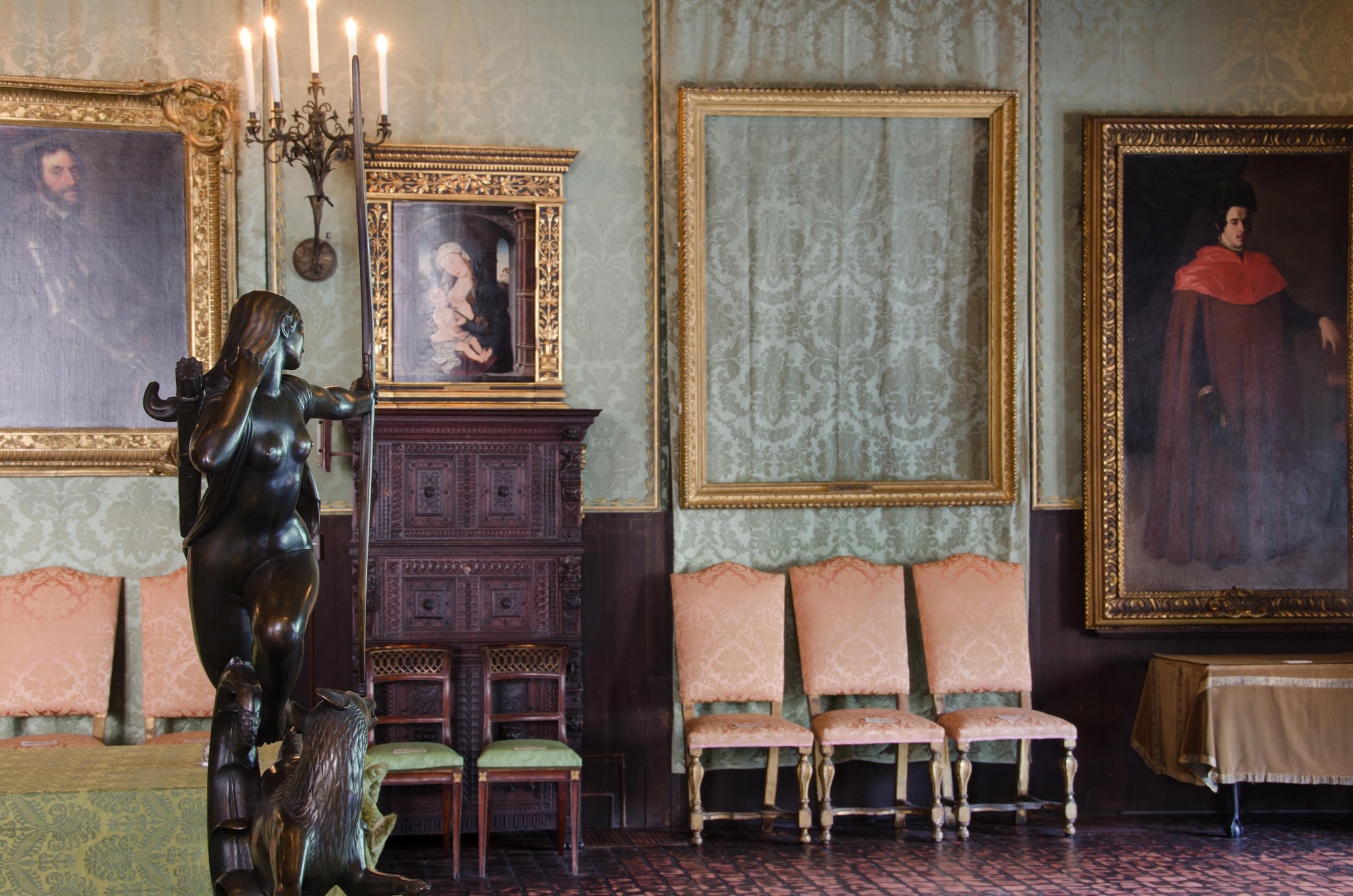
The empty frames at the Isabella Stewart Gardner Museum, Boston. The largest held Rembrandt's Storm on the Sea of Galilee, painted in 1633. Thirteen works left the building in the March 1990 theft, and the museum keeps the empty frames on the wall. The exact rhyme is Ghent, where the Just Judges frame stood empty from 1934 until 1957.
Source: Wikimedia Commons(opens the catalogue record in a new tab)Ethiopia / 17th c.
An Ethiopian triptych icon
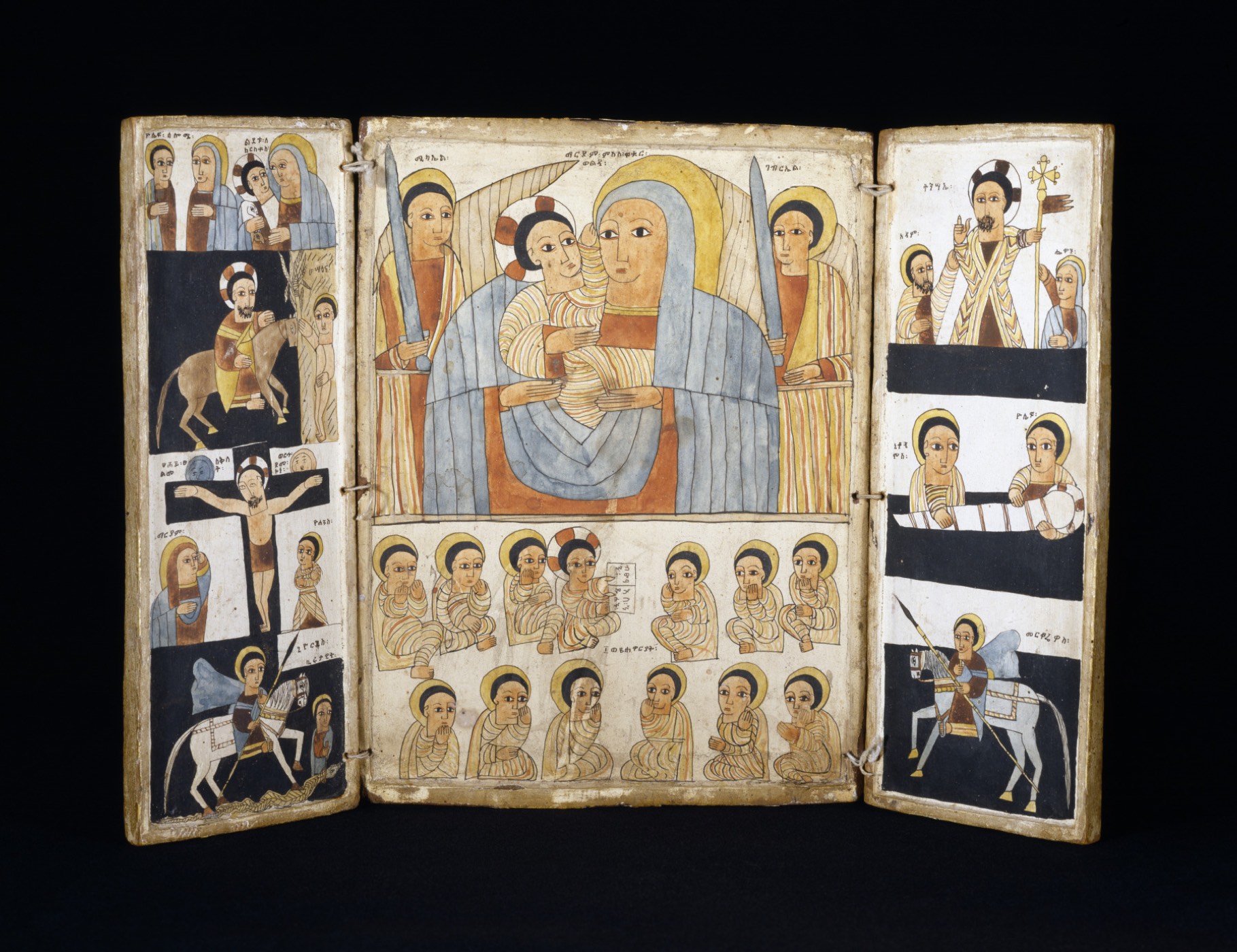
Ethiopian triptych icon, Solomonic period, Walters Art Museum. An entirely independent triptych tradition: local wood, gypsum ground, indigo and orpiment, and hinges of twisted sinew or parchment rather than iron, engineered so the wings open flat.
Source: Wikimedia Commons(opens the catalogue record in a new tab)Modern / 1887
Animal Locomotion, plate 758
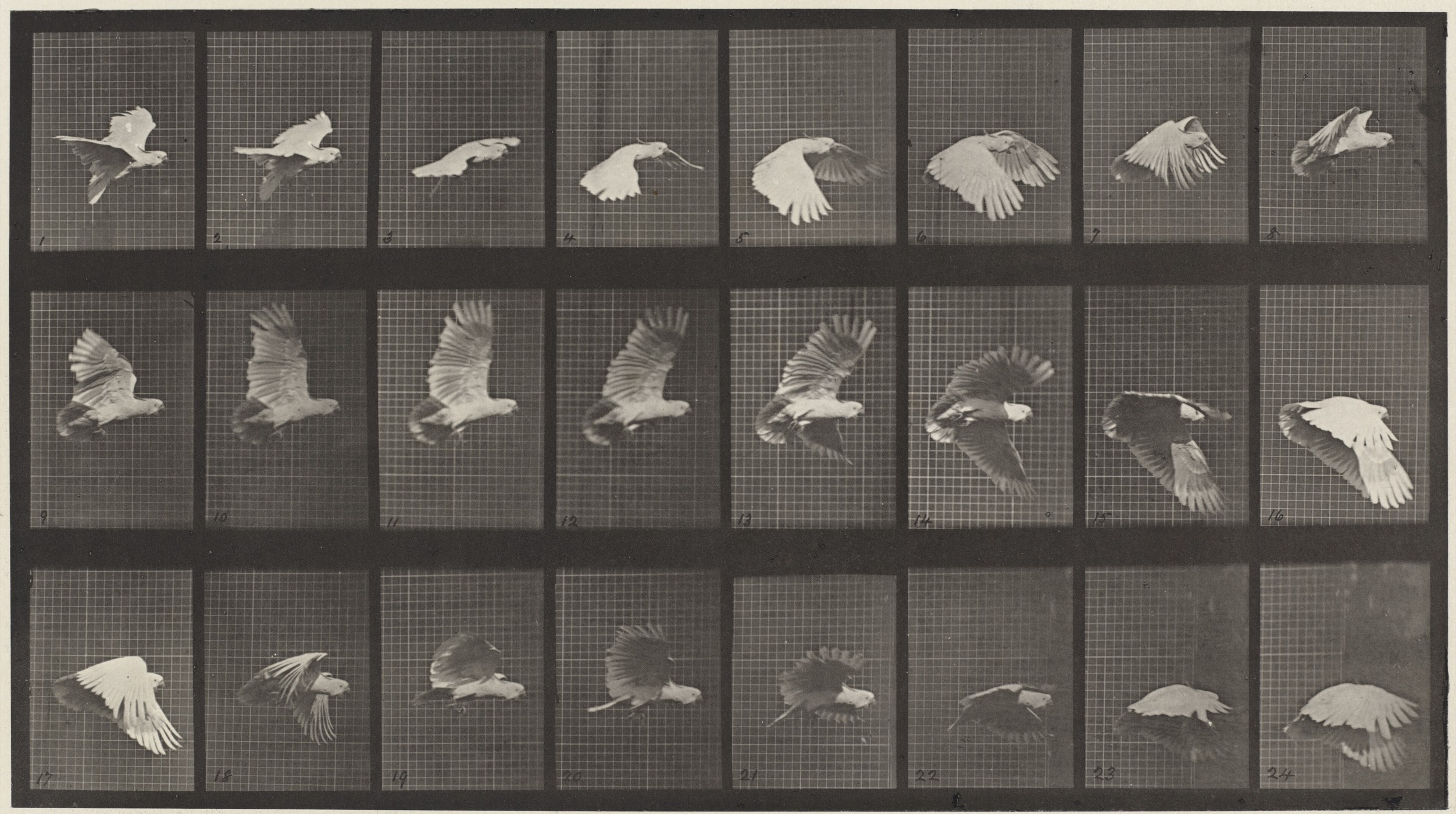
Eadweard Muybridge, Animal Locomotion, 1887, plate 758. The first mass-produced modern polyptychs. Bacon owned and cut up Muybridge plates; they survive in his studio archive at the Hugh Lane, Dublin, and a Muybridge pelican becomes a Fury in his 1981 Oresteia triptych.
Source: Wikimedia Commons(opens the catalogue record in a new tab)1969
Three Studies of Lucian Freud
$142.4m
Christie's New York, 12 November 2013
meaningless unless it is united with the other two panels
Bacon met Lucian Freud in 1945 and the two of them were close for thirty years, until an argument in the mid-seventies finished it. He painted this in 1969. Three canvases, each one 198 by 147.5 centimetres, with Freud on a bentwood chair in all of them.
The panels were sold off separately not long after. Bacon was furious and wrote that the work was meaningless unless it was united with the other two panels. A Roman collector called Francesco De Simone Niquesa went looking for them and had the three back together by the late eighties.
Christie's sold it in New York on 12 November 2013 for 142.4 million dollars, the most anyone had paid for a work of art at auction until a Picasso went past it eighteen months later. Elaine Wynn bought it. Her family said in September 2025 that it is going to LACMA.
And the studio
Why we chose this name
We worked as L2D for more than fifteen years. Coming out of 2020 the studio had grown into something that name no longer described, so we gave the job of finding a new one to the team.
A triptych holds together because each panel is cut to sit beside the others and carry its own share of the picture. Strategy, design and development work that way here, which is why the name stuck.
Strategize
We work out what the project has to do, and who it has to do it for, before anyone opens a design file.
Design
We draw it, run real content through it, and keep going until it holds up.
Develop
We build it to stay fast, and to be maintainable by whoever inherits it.
The longer version is in why we rebranded.
Triptych FAQs
- What is a triptych?
- An artwork in three panels, hinged together or set side by side. The centre panel carries the main scene and the two wings sit beside it, and on most historical examples the wings fold shut over the middle.
- Why do triptychs have three panels?
- The form started as a hinged pair, a Roman consul's ivory tablets. Adding a centre panel gave the composition a main scene with two supporting ones, and the hinges meant the whole thing could close for travel or for ordinary days and open for the occasions that deserved it.
- What is the most famous triptych?
- The Garden of Earthly Delights by Hieronymus Bosch, painted around 1490 to 1510 and hanging in the Prado. The Ghent Altarpiece of 1432 is the more influential one: it anchors the whole wing-altarpiece tradition that came after it.
- What did a closed triptych look like?
- Usually far plainer than the inside. Many carried grisaille, painted imitations of stone statues, and some just the owner's coat of arms. The colour was saved for feast days, so most people who stood in front of one saw the closed face.
- Are triptychs still being made?
- Yes. Francis Bacon painted Three Studies of Lucian Freud as a triptych in 1969, and in 2013 it sold at Christie's for 142.4 million dollars, at the time the highest price ever paid for a work of art at auction.
Image credits (27 works)
- Overwritten with the names of the dead · Wikimedia Commons, CC0.
- Consular diptych of Areobindus · Wikimedia Commons, Public domain.
- The Tamamushi Shrine · Wikimedia Commons, Public domain.
- The Harbaville Triptych · Wikimedia Commons, Public domain.
- Byzantium nested inside a reliquary · Wikimedia Commons, CC0.
- A cardinal's travelling altar · Wikimedia Commons, Public domain.
- The altarpiece inside the altarpiece · Wikimedia Commons, Public domain.
- Heraldry as the closed state · Wikimedia Commons, Public domain.
- Joseph's mousetrap · Wikimedia Commons, Public domain.
- The Mystic Lamb, open · Wikimedia Commons, Public domain.
- The Ghent Altarpiece, closed · Wikimedia Commons, Public domain.
- Still missing since 1934 · Wikimedia Commons, Public domain.
- In the Altaussee salt mine · Wikimedia Commons, Public domain.
- A triptych made by cutting · Wikimedia Commons, Public domain.
- Aimed at the dying · Wikimedia Commons, Public domain.
- The contract that specified bread · Wikimedia Commons, Public domain.
- The pirate triptych · Wikimedia Commons, Public domain.
- The shock that changed Florence · Wikimedia Commons, Public domain.
- The Garden of Earthly Delights · Wikimedia Commons, Public domain.
- The butt music of hell · Wikimedia Commons, Public domain.
- The triptych shrunk to fit a palm · Wikimedia Commons, CC0.
- The altarpiece as medicine · Wikimedia Commons, CC0.
- The Beeldenstorm of 1566 · Wikimedia Commons, CC0.
- The Descent from the Cross · Wikimedia Commons, Public domain.
- The empty frames at the Gardner · Wikimedia Commons, Public domain.
- An Ethiopian triptych icon · Wikimedia Commons, Public domain.
- Animal Locomotion, plate 758 · Wikimedia Commons, CC0.